

Transit is ... sewers, light standards, fibre lines, and homes.
A plea to not forget what transit really is.

Before diving into the body of this post, I was recently on a rather cool podcast called “The Other Stuff” produced by Vin Verma and his team at New.
I really enjoyed our conversation; it was rather unbounded — though naturally we talked a lot about transit and “RMTransit”.
While I moved to Toronto because this city was building more (and more transit infrastructure) than any other in North America, and that’s a pretty good thing —
I haven’t really ever been debated on this contention, but I am always slightly anxious that I will be.
Los Angeles is the only other city that could claim to come close (New York is doing a small fraction of what Toronto is doing these days), but Los Angeles is doing a lot of questionable, poorly-connected projects that I would argue functionally deliver less than Toronto’s 4 subway projects (which will deliver 30 new stations), major regional rail expansion (building from a stronger base) and broad transit improvements.
— unfortunately its also been a bad thing. This may change, and I hope it does. A big issue you see in places that build and operate low amounts of public transit (North American cities generally) and which have undergone a low-build period (Toronto through the 2000s), is that each project gets elevated to the status of grand civilizational program. The Eglinton Crosstown for example is a modest capacity subway-surface line: it’s not really that big a deal, but because it was delivered so slowly (still hasn’t fully arrived somehow), and because it was the last serious subway in the city since the 60s, it was treated like we had built our own Crossrail (a project which is at least an order of magnitude more impressive), instead of a midnight cram project before the Vancouver Olympics (and Vancouvers project was better).
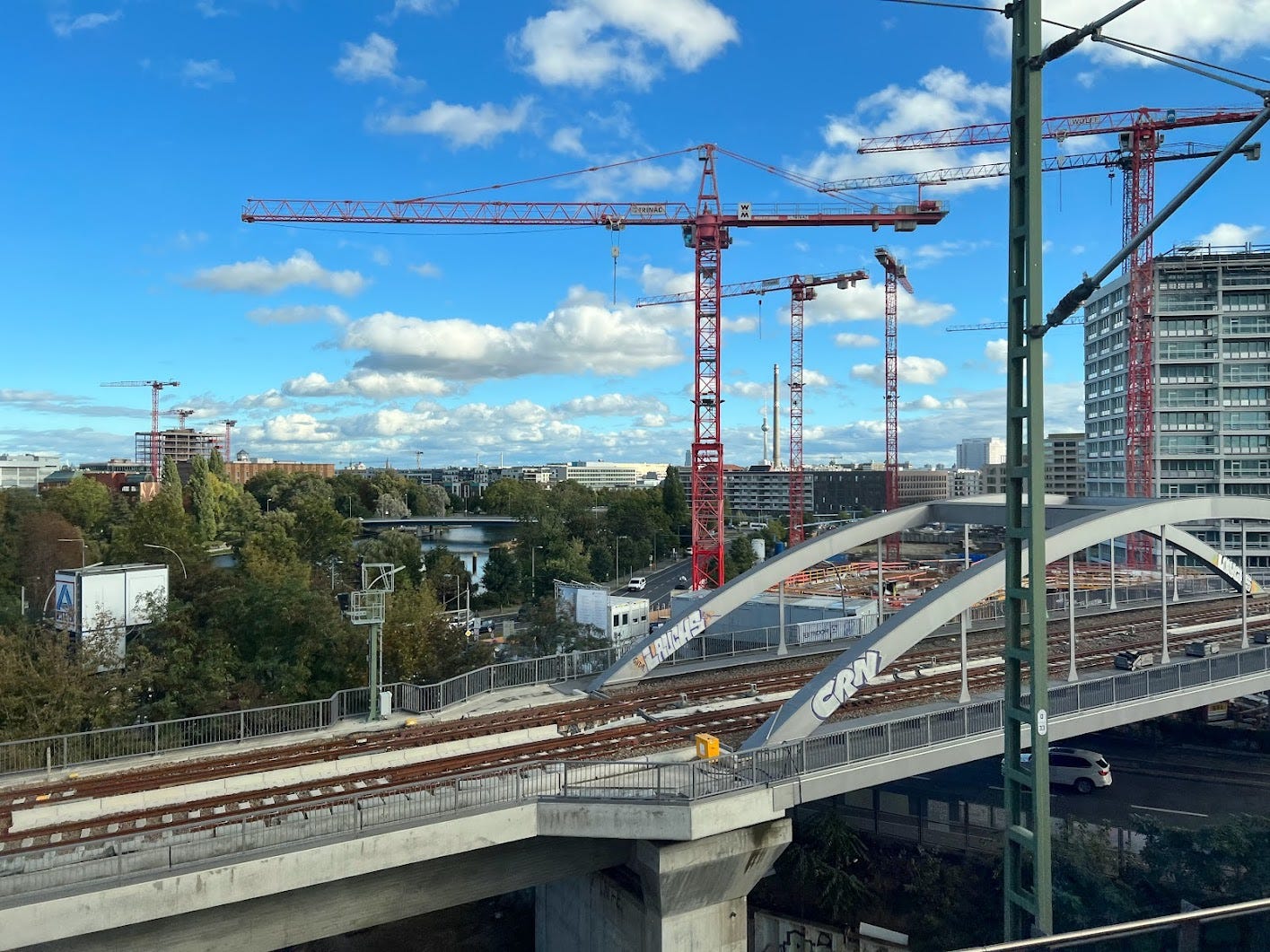
This problem is not at all unique to Toronto: I’ve seen minor light rail extensions in the States open to the same fanfare you’d imagine you might have for landing someone on the moon.
Now, celebration is good, but the nefarious character who tags along is … public interest. A city proposes even a modest infrastructure project, the media acts like it’s a modern Three Gorges Dam, and next thing you know costs are exploding and NIMBYs are out in full force. People should be interested in projects, but the energy and attention we point at big infrastructure may not actually be helpful, especially because North American media is by and large bad at covering this stuff and more or less seems uninterested in getting better.
But, we just can’t help blowing everything into a massive thing — hyperbole sells I guess — and to some degree this is a loop of doom. Major infrastructure projects, especially progressive-coded and managed ones end up getting saddled with tons of requirements that are seemingly designed to solve all of society’s ills while strangling the project like an anaconda. There’s often a real sense — one that I have seen in Toronto and Montreal for sure (and which sometimes feels like a reality in New York) — that the current projects being built, particularly anything ambitious, will be the last project we ever do, before we fully accept death by cost disease, climate change, or depopulation.
The funny thing is, outside of isolated cases of really truly major projects, this really does not happen for roads. I remember the SR-99 tunnel project in Seattle got some serious continent-wide coverage, but mostly you never hear as we spend billions building and rebuilding roads.
A friend once pointed out the lack of engagement, and endless studies, and consultation, and “trying-to-solve-all-the-worlds-problemsitis” with roads, and simply said: “our society depends on roads in a way it does not depend on transit and people would never let road building get bogged down in the way transit building has been”. This is very sad for those who’d like more transit, but seems basically correct to me.
My point in all of this is that the way we engage with these projects is probably not healthy and also probably doesn’t make getting them done easier. Roads get built because we don’t make a big fuss about them, and because so much road work gets done in the background people often don’t seem to notice how much we spend on, and orient society around them.
For transit advocates, what this probably means is trying to talk about transit projects less, while making quiet (as much as possible) moves on funding and approvals. The truth is we need to stop taking a victory lap after nailing 5 steps forward and get on with the next thing, advocates are fighting a gruelling hard uphill battle and need to act like it, we can celebrate when we are at German-level transit, or when we’ve done more than paint one bike lane.
I think it helps to take it back to the title: sewers, light standards, fibre lines, and homes — things we need and things we actually build everywhere and constantly, things that happen in the background.
I get it, transit is charismatic (in the social sciences sense), but we almost need to change that. Imagine instead of a new subway or tram we are getting a new trunk sewer, and if you want to learn about it read the meeting minutes (all the marketing and comms around transit seems to have a reverse correlation to actually building this stuff cost-effectively, which sort of makes sense. In Spain, a dollar of marketing is a dollar not going to concrete, which is far less expensive because Spaniards are mysterious infrastructure wizards). In many places, transit is much more like this: do you think every resident of Guangzhou or Shanghai can tell you about all the transit being built in their city? They probably could barely tell you what’s happening in their neighbourhood, and observing JR Urbane Network’s own observations at Chinese metro openings more people than you’d expect are surprised. It also says a lot that serious technical drawings — which we treat like military secrets — are pretty available, and sometimes basically seem to be “the comms”.
At the end of the day, part of getting more changes to the built form of our city and streets, and transit infrastructure constructed is literally making change and building things for transit normal. To some extent that means that like sewers and roads, we should always be doing things; part of why people make a fuss about a new light rail line is because you don’t constantly see that, but we as advocates also don’t need to pour diesel on the fire by acting like this is something the NIMBYs and NIMBYs-in-waiting should be watching.
Agreed that the bigger the deal, the more people want to force it to be perfect. The rarity of transit builds, means both less construction and project management skills are well developed, and the more focus and push for perfection is required, the more impossible it is to build especially given the relative lack of project management experience.
I would say however, that we need to be careful judging a project too heavily by its capacity. It is the crucial question of decent running speeds, high frequency and actually making the connections with enough capacity for the load, that make a network function. I would suggest Eglinton at its Eastern end, will struggle with the decent running speeds, in part because of too close stops. However, by and large, the number of GO lines it also connects to mid town, and that it allows a ride between subway branches, makes it more valuable than its peak capacity would suggest. Finch west - needed to be longer in both directions, as well as faster. Its value for the network would have been radically higher, connecting to both Kitchener GO and the eastern leg of line 1 (and the bus terminal at Finch). I fully agree, because of politics, the network value is not considered enough, and the politics of "connecting" a location weighs too heavily.
"the current projects being built, particularly anything ambitious, will be the last project we ever do" has been something that really irks me. and I'm glad you've mentioned it here. I especially am bothered by it in relation to Alto. It's treated as a grand nation building project like the CPR was, forgetting that the CPR's utility was in all of the lines that it enabled to be built off of it. Alto needs to be viewed as a first step, but instead it's being treated as the goal. I desperately hope that the approach can change to one where where even at this stage, the question is being asked, " and what will be building after Alto?".