

The Eglinton East LRT, Toronto's Planning Problems, and Five Better Projects.
Keeping bad projects around is bad.

The Eglinton East LRT is not a very good project. That almost feels harsh to say, but it just isn't, and the reality here is that projects that aren't good getting built (along with questionable execution of course) is what has created a lot of our present transit problems in Toronto — most notably with the opening of the Finch West and Eglinton light rail lines.
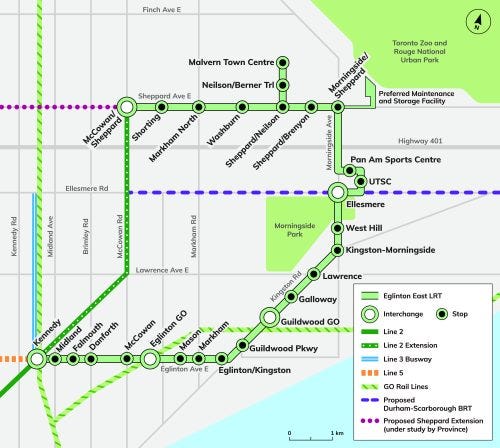
While for many years many Toronto transit watchers convinced themselves that replacing a bus route with a median-aligned surface tram made planning rapid transit easy, I was never convinced because I had seen how a similar “LRT” project where I grew up — the Surrey Langley light rail line — would only have improved travel times over buses by 1 minute.
Similar data didn't seem to be made widely-available in Toronto, cynically because this would have made the projects we were developing look much worse. However, now that they're open, we've kind of learned this the hard way. Eglinton to be fair does seem to be performing much better than Finch, but still, even just simply beating the bus doesn't feel like a great value when you've spent billions of dollars on a new transit project.
As has been heavily covered, a lot of these problems come down to weak transit signal priority. What I think has been appreciated less is that the extent to which we can have good transit signal priority is limited because of the way we've designed our projects.
And speaking of design, even if everything was working well and perhaps more so if people didn't have the big issue of the lines not working well to think about, they are just pretty ugly. These lines might have looked okay if built 20 or 30 years ago, but Europe has been building more attractive infrastructure for over a decade now and it's disappointing that our brand new line lacks many features that were commonplace in other cities long ago (for example, the trains have low-fidelity LED screens which would be acceptable 20 years ago but now feel very dated).
And then downstream of the weak priority and design decisions made on these lines, the speeds just aren't great. Beating traffic feels good, but it's not special when you have an entirely dedicated Lane in front of you with no other vehicles in it to block you. The thing I've been repeating for years is that Toronto doesn't have a problem with transit availability, it has a problem with the availability of fast transit, and at the most generous, these lines are quick some of the time — they are not transformatively fast in the way subways have been.
I think we could have predicted a lot of this, and I've talked about this at great length over the years as well. Suburban Toronto is certainly covered and served by transit, but it's still a car-oriented locale with conservative-leaning politicians. I'm not sure how we thought we were going to nail things like transit signal priority here when we can't even get the downtown streetcar network working properly where the politicians should theoretically be much more supportive, and where we already have the rails laid!
So the natural question is, how could we be deluded into thinking another project like this is a good idea, and that's more or less with the Eglinton East light rail line is.
I’ve heard someone previously try to sell the project a connecting so many destintions, Malvern, UTSC, GO stations, and the like! But the issue is that these are just random destinations, Guildwood GO and Eglinton are somewhat redundant with one another, it's not clear to me that this is the best way for most people to get to UTSC, and Malvern residents might benefit so long as their destination is on this route, and as long as it’s actually much faster than the bus — there are a lot of big ifs.
Now, to their credit, the city and mayor have been talking about grade separation (it makes me really frustrated after talking about this for years that the riders of Finch West need to be trapped on a slow tram before leaders would listen). However, the issue is that the ground has shifted, and this is why you have to interrogate your ideas today and not years down the road, if you don't present great ideas, people might not entertain them and so you won't get the chance to adapt them later.
The Scarborough transit version of this is that the Scarborough Subway makes the north-south part of the Eglinton East light rail line much less relevant. For a large quantity of trips, it will be faster to take a bus to or from the new north-south subway; sure, you will have to get on the bus, but because the subway is so much faster than the tram, and because the tram is at best only slightly faster than a bus, bus-plus-subway still ends up being the fastest option. Furthermore, it seems like there's a very good chance that the shepherd subway gets extended at least to McCowan, and if it gets extended further east, perhaps along elevated guideways, then you eliminate most of the remaining trips where the light rail line might have made sense because now you can go both east-west and north-south much faster on these new subways, connecting to final destinations with short hops on buses.
What's funny about all of this is that there is definitely a bias against buses, and while politicians obsessed with subways always get treated like elitists, I don't really see a difference between being obsessed with the subway because you think buses are for poor people and being obsessed with the tram because you think buses are for poor people. There has been so much language over the years and decades about how Scarborough needs transit, but anyone who's actually been to Scarborough will know that it's absolutely laden with it — again, fast transit is what's needed not transit.
The most significant irony of transit city is that while a lot of ideological folks often talk about it as if it's a highly-detailed and intensely well-grounded plan. The reality seems closer to it being allowed to be political (in the form of trying to spread the gravy around with light rail in almost every word of the city) because it was a plan mostly supported by progressives.
Of course, my frustration is also that the city and its politicians frequently talk about projects like this as if they are super cost-effective, mentioning impressive sounding numbers of riders, as well as stops and track length. But of course this is all a charade: the reality that those who follow transit closely have long understood is that the light rail lines Toronto was building were not actually going to be good transit, and so the number of track miles or stops was irrelevant.
Instead of actually building institutions that were capable of delivering the type of subway abundance that would let most city councilors tell their constituents “look, we have so many new subway stations on the map in our ward!” (Like say Madrid or Seoul), the solution is apparently to try to deceive the public into thinking that a tram running down the middle of the street is somehow the same as a subway if we put it on the subway map.
I guess my point is, the city should have recognized that when the province wanted to get much more involved in transit in Toronto that it needed to pivot, but it's pivoted late and the pivot is about 1°. And I'm just not very sympathetic — the city of Toronto doesn't actually seem focused on what makes transit and mobility best for residents, but instead building political plans that city politicians and I guess some city staff believe elevate the status of the city. A good example of this is GO: there are already in north-south and east-west GO lines in Scarborough, and if the city of Toronto didn't have such a strange attitude that treats GO as if it is exclusively for suburban residents outside of the city, it might have spent the last several decades creating great bus connections and pushing the province to enhance service on these lines sooner. I can totally imagine a world where much like with the subway network, there are stations at the major arterials with big bus terminals that let people from almost anywhere in a place like Scarborough get to a train station that lets them get on a train that helps them get places quickly.
What's funny is that to some extent, the city is doing the right thing by creating a sort of master plan, the issue is that it doesn't seem like the city of Toronto realizes that the GTA isn't just the city of Toronto anymore and that it doesn't really make sense for one single city to plan things in a vacuum. Funnily enough the whole “we have a master plan!” thing, while not actually acknowledging the realities of funding, population dynamics, and changing priorities takes me from sympathetic to irritated with the city's efforts.
So to just reiterate, what we end up having is a bus that is more or less turned into a bus on rails along Eglinton East. And with the biggest trip generator along the route, the University of Toronto Scarborough campus instead sending most of its trips to the new subway being built via buses. This means that this project basically just exists as a rail replacement of the existing local bus for local trips. Maybe that would make sense in Europe where they're good at building trams and they can do stuff in expensively, but it doesn't make a single lick of sense in Toronto, because we haven't picked so much of the low-hanging transit fruit.
But I don't want to rant for this entire post, so like I mentioned from the front, I want to talk about five conceivable things the city of Toronto could put its efforts into that would provide better transit for Scarborough that I think would be better plans (more benefits, more reach, lower cost) than the current Eglinton East light rail line.
Idea 1: The Scarborough Express
My first idea is one that’s been kicking around for many years. It's essentially a BRT-lite grid that would serve Scarborough, and if I'm being honest, ideally the service could continue up north to Highway 7 so you end up getting seamless connectivity into York region as well. I get that that's an absolutely insane proposal if you are used to the way Toronto does things, but as it turns out, people living north of Steeles also need to get around, and it's absolutely ludicrous that suddenly when you go into York region the buses run every 40 minutes. Part of this is obviously conservative York region politicians not wanting to spend money on transit, but I think it's also partially a sort of Toronto attitude that the city doesn't need to lead the surrounding region and can instead exist on a sort of island separate from it.
I think Toronto should basically build parts of a network like this no matter what happens, covering areas of Scarborough that don't have true rapid transit. I'm not going to repeat myself 10 times and say it again and again, but some combination of BRT-lite bus routes plus the other four ideas I have would be a sensible way to move forward as well.
Anyways, the point of this network would be to cover basically the whole eastern part of the city with 12 different routes: 6 east-west, 5 north-south, and a short route connecting Malvern to Scarborough Town Centre. These routes would connect Scarborough's major hospitals, numerous GO and subway stations, York Region’s Viva on Highway 7, and the University of Toronto and Centennial College.
Now, these routes would not be over-the-top like VIVA with massive glass structures, and more importantly would not be like VIVA because they would probably each have buses every 8 minutes or so from early in the morning until late at night and then 15 or 20 minute service in the overnight period. The stops would also still be nice, with larger canopies, bike lockers so that people could actually get to a stop more easily, next bus screens, and designs that make them visible on the landscape so that people can easily actually find the nearest stop.
In terms of actually making them Express, the key detail is extremely limited stops, but of course you would also do transit signal priority, queue jumps, and dedicated lanes where they would actually help bypass traffic (saving cost where you don't actually need them).
In terms of the bus vehicles, I would suggest all articulated electric buses; it would be especially nice if we could manage to get some nice European buses, and extra points if we protected for bi-articulated buses if that is a road we decide to go down. In terms of propulsion', electric is obvious, and I really think in-motion charging makes the most sense especially because you can determine easy sections of each suburban arterial to put up wires on, leaving tight underpasses and other stretches of the route without wires to the extent that the battery capacity of the buses allows.
I've written out roughly what routes I would implement, though if it's of interest perhaps I could do a follow-up post where I go through this in more detail. While I mentioned specific arterials, The routes would likely turn onto other streets at the ends to connect with nearby stations and the like, and they would also divert off of these arterials to serve major destinations where applicable.
North-south
Birchmount (SX2)
Midland (SX4)
McCowan (SX6)
Markham (SX8)
Morningside (SX10)
East-west
St. Clair-Kingston (SX1)
Eglinton (SX3)
Lawrence (SX5)
Ellesmere (SX7)
Finch (SX9)
Steeles (SX11)
Connector
Malvern (SX12)
I think if we actually did this stuff properly, then these routes would be just as deserving of being on the TTC map as the streetcars. And I'd actually think a Scarborough-specific transit map showing all of the subway and GO stations and the grid of new express bus routes would be valuable.
Idea 2: The Scarborough Liner
The Scarborough liner idea is inspired by the automated people movers widely used across Asia, especially in Japan. The concept here would be to connect Scarborough Town Centre with Centennial College, Centenary Hospital, and the University of Toronto-Scarborough. Most of such a line could be built elevated above ground, which would seriously reduce its costs, and the yard could perhaps even be built where the old Scarborough rapid transit yard was. This system would be automated and would use small trains, which would mean along with the elevated construction, costs would be very low. Service could run every 4 minutes and stations would have platform screen doors.
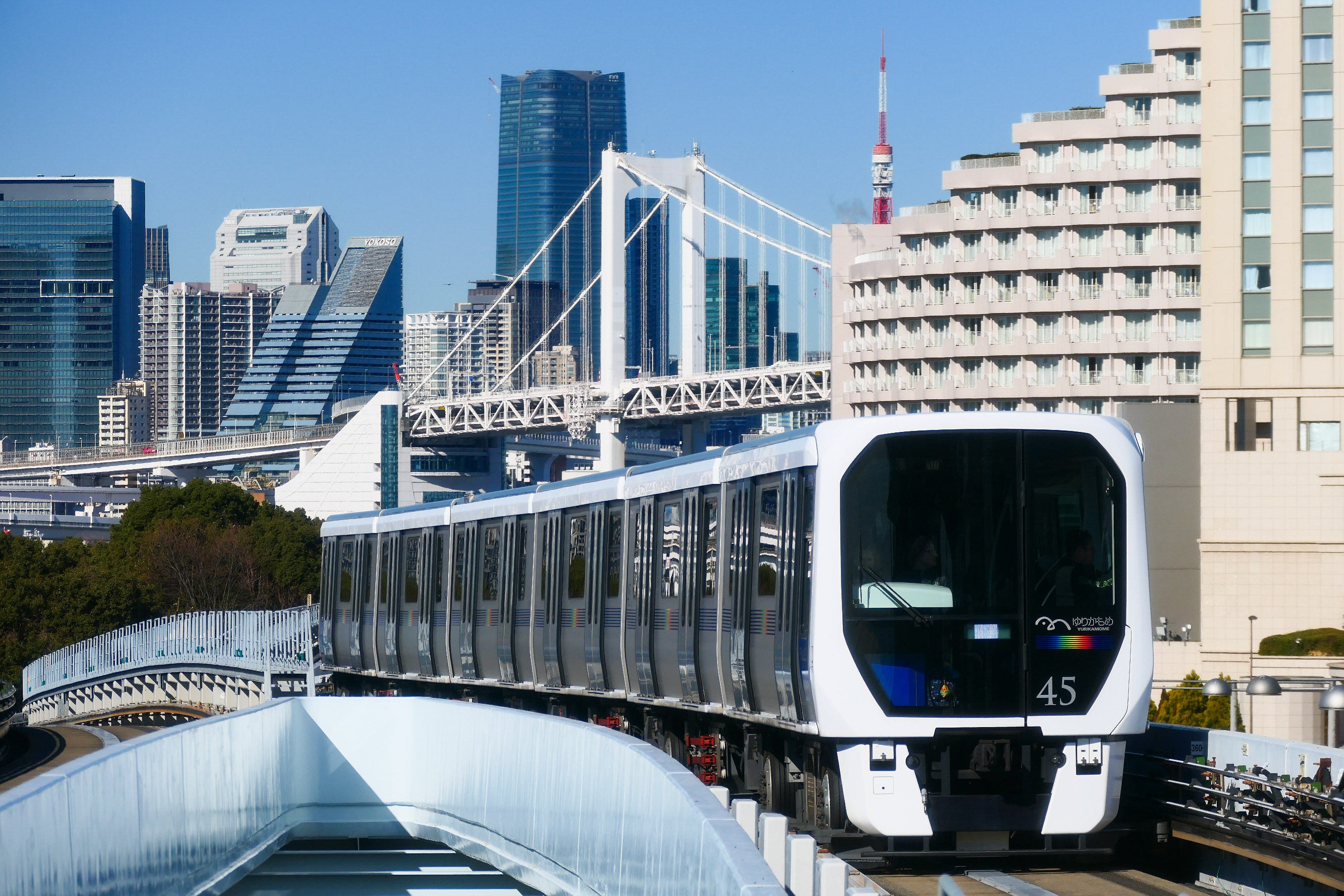
As a second phase, you could extend the line south — albeit with some tunneling — to Guildwood GO station, creating direct links to Scarborough's most important destinations from the east south north and west.
Idea 3: SmartSpur
The SmartSpur idea would sort of be a variant of the Scarborough liner idea, however it would substitute the automated people mover technology for a spur off of the Stouffville GO line. This would likely cost more money, as stations would need to be larger and you would probably need to do more tunneling, however it would create more direct links across the region.
In order to facilitate this project, GO would need to have finally started rolling out EMUs (ideally also in a shorter format because we do not need 300m platforms at Scarborough Town Centre and UTSC), and would also need to have all trains stop at Scarborough to facilitate connections to the Lakeshore east line that would not be available at Guildwood.
Idea 4: Accelerate Sheppard Subway to Pickering and Line 2 Extension
Another option would be to strengthen the subway “cross” within Scarborough. Line two is already going to extend fairly far north, but could go all the way to Steeles Avenue or potentially beyond if York region wants to kick in funds and build a ton of housing along McCowan and near the Markville Mall site. This would add new interceptions to the finch and steals bus routes.
At the same time. the Sheppard Subway could be extended further east, reaching McCowan at Scarborough Town Centre and then roughly continuing on Ellesmere past the hospital and Centennial College to the University of Toronto.
Obviously with this solution you don't get rail transit a short distance from most people in Scarborough, but the reality is you also don't do that with the current Eglinton East plan. On the other hand, a Subway “cross” would mean short bus trips to get to the subway for many people, and the ability to get across Scarborough quickly, with many destinations not requiring a bus on at least one end of the trip.
Idea 5: Just Better Transit
The last idea I'll put out there, is just spending the money on making transit in Scarborough nicer. That could mean screen doors at all of the subway stations, enhancements to the GO stations that haven't been enhanced yet. Proper bus exchanges akin to the ones that have been built in York region (to serve like one or two buses an hour as opposed to the one or two buses every minute you see in Toronto) could be built in locations that aren't on the rail network. You could work to aggressively upgrade and electrify buses across Scarborough. You could build new affordable housing and TOD sites, and you could also build out a fantastic bike Network.
My point in saying all of this is not that we shouldn’t build and improve the transit ofsScarborough, but just that I know we can come up with better ideas than what we currently have, which admittedly was a plan created long ago.
Canada has looked at trackless trams instead of Light Rail, as Light Rail is so expensive to build, with heaps of construction emissions from steel and construction materials and not to mention the disruption of construction, what are trackless trams that 1/20 th the cost of light rail, can be up and running in months, and have better resilience. If you want an innovative mid-tier mass public transport system, watch these links. Why would we build light rail?
https://www.youtube.com/watch?v=9QhW-Dhnguo
DRT英语.mp4
https://tracklesstrams.nz/media-related
You mention that Toronto is not as much interested in transit as it is in politics. This is true not only for transit but for every decision the city makes. To fix transit and every other thing (dirty parks, garbage pick up, etc.) the Provincial government must step in and replace the mega city with boroughs, perhaps extending into the suburbs, and a corresponding ‘metro’ structure for transit and police. Back to the future!