

Is the wild west getting rail policy right?
Alberta has managed to make a lack of progress look sensible.

Alberta has managed to talk a lot about rail recently: a train to Banff, high-speed rail, or a Calgary airport connector. But the province has in some senses experienced a “lost decade” — many plans seem unlikely to go anywhere fast, and the things that are getting built are of questionable quality — a sad fall from grace for a place that used to build good transit affordably.
People frequently ask us what jurisdictions are doing the right things for transit rail in North America. Here, Alberta offers some cautionary tales, but also some lessons.
Transit in Alberta periodically slides across our screen. In the last few years, we’ve seen Edmonton’s new southeastern tramway open — the Valley Line — a proposed Chicago ‘L’-esque rail route to take trains from Calgary’s Green Line across that city’s downtown, and a passenger rail “masterplan.” A fairly in-the-know friend of The Transit Brief recently commented to us that it seems like Alberta is doing the right things — cutting tunnels and costs, and masterplanning.
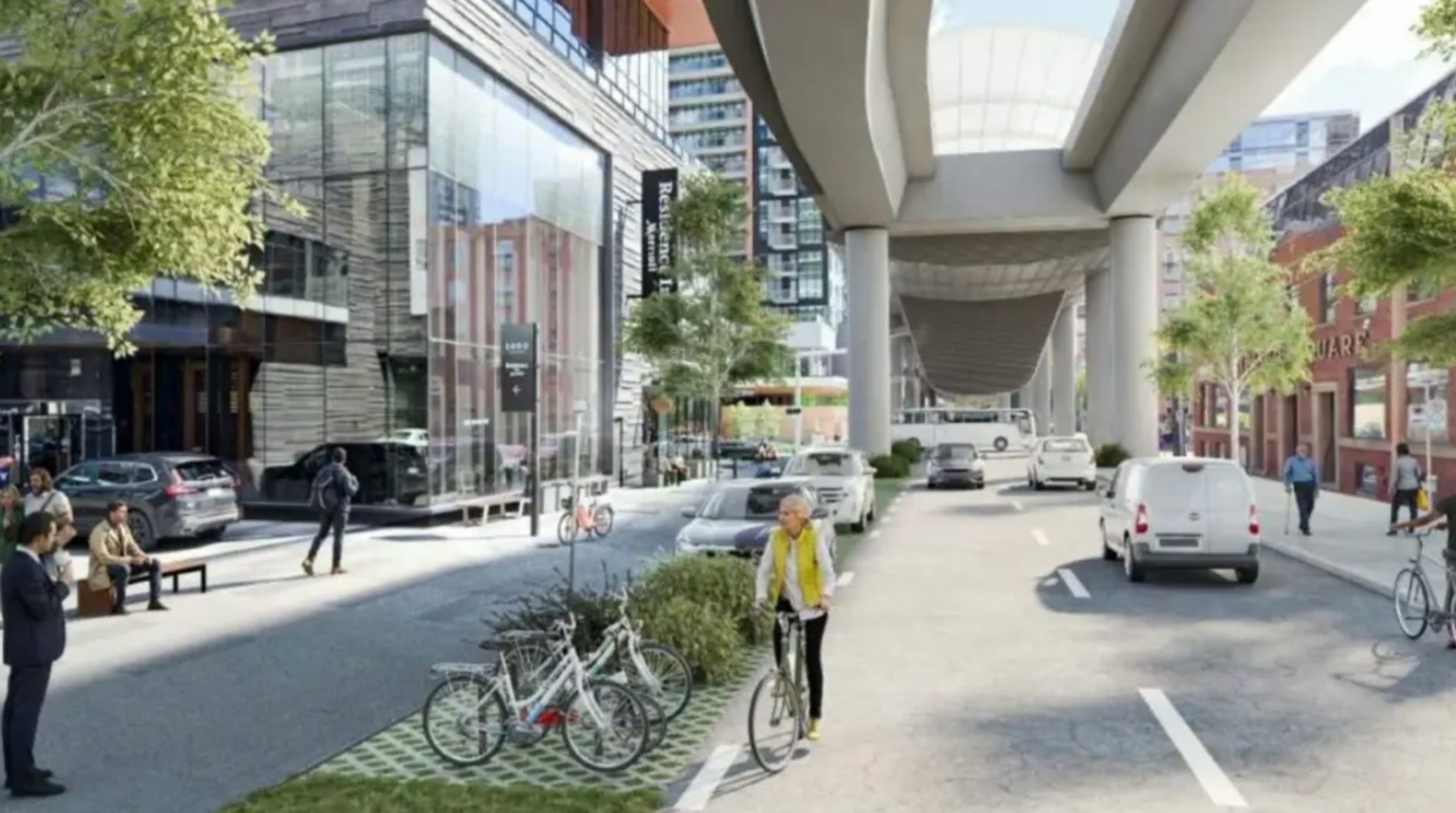
But we don’t think that’s entirely correct.
It’s understandable how what Alberta is doing now could be perceived as a competent, technocratic approach to getting rail built out, and parts of it actually probably are that, or at least have been historically. The province has been more forward-looking in transit development and somewhat more disciplined on cost. However, the value side — that is, getting people riding transit — cannot be sensibly improved with stagnant networks in growing cities and worse projects. Such endeavours cost a lot both in terms of real and political capital, but don’t move the needle on ridership. Projects like the Max BRT in Calgary that provide worse service than many standard buses in Toronto or Vancouver could, for example, worsen the perception of transit. Masterplanning is conceptually good as well, but only so long as it’s not getting in the way of building for the present and taking advantage of all available funding.
The Good Old Days.
Historically, Alberta was shockingly good at urban rail development. The adoption of light rail from Germany was much more of a lift-and-shift than it was in America, and so the high-floor light rail systems — the Red and Blue lines in Calgary and the Capital and Metro lines in Edmonton — managed to provide close to metro-level service and speed for a small fraction of the price. In Edmonton, they even combined with a Swiss-style pulse scheduling system that formed the basis of a great transit network for the whole city.
The cities also really did a pretty good job building at a consistent rate: Calgary in particular, with new extensions opening regularly to service new areas of development — often using strategically reserved land, a practice which continues to some extent today, and often executed as small projects managed by the city and delivered at fairly low costs in the Canadian context.
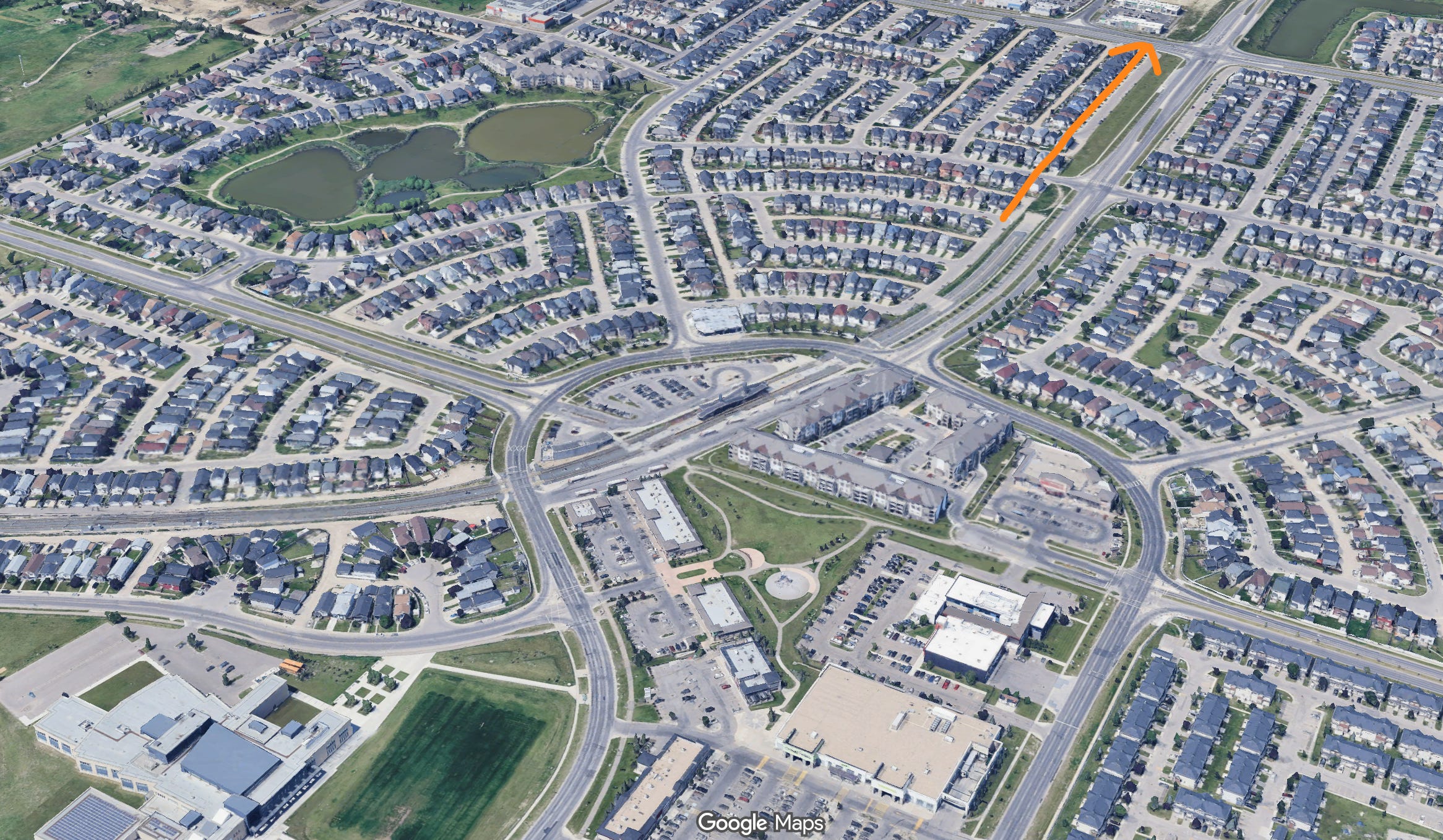
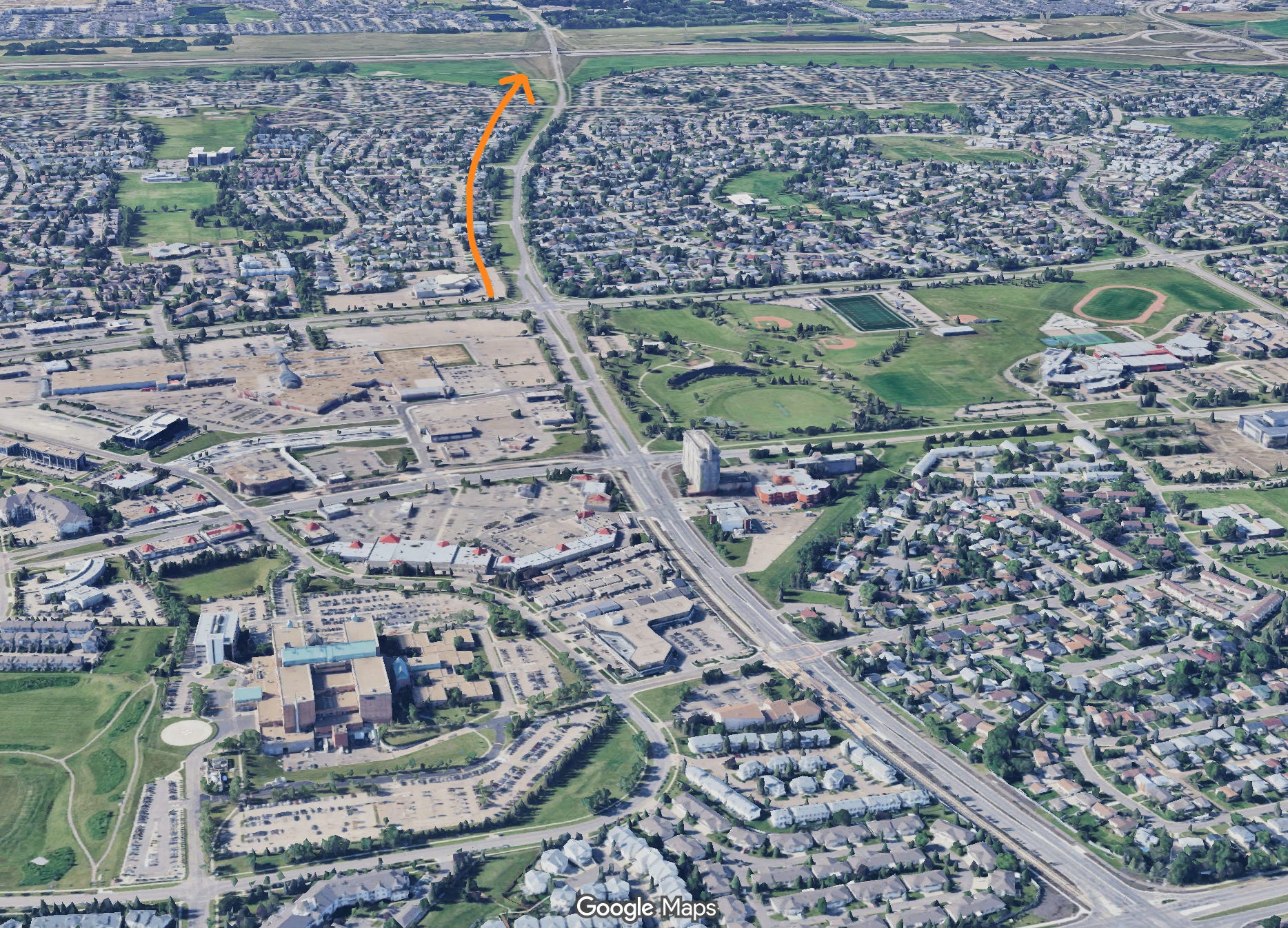
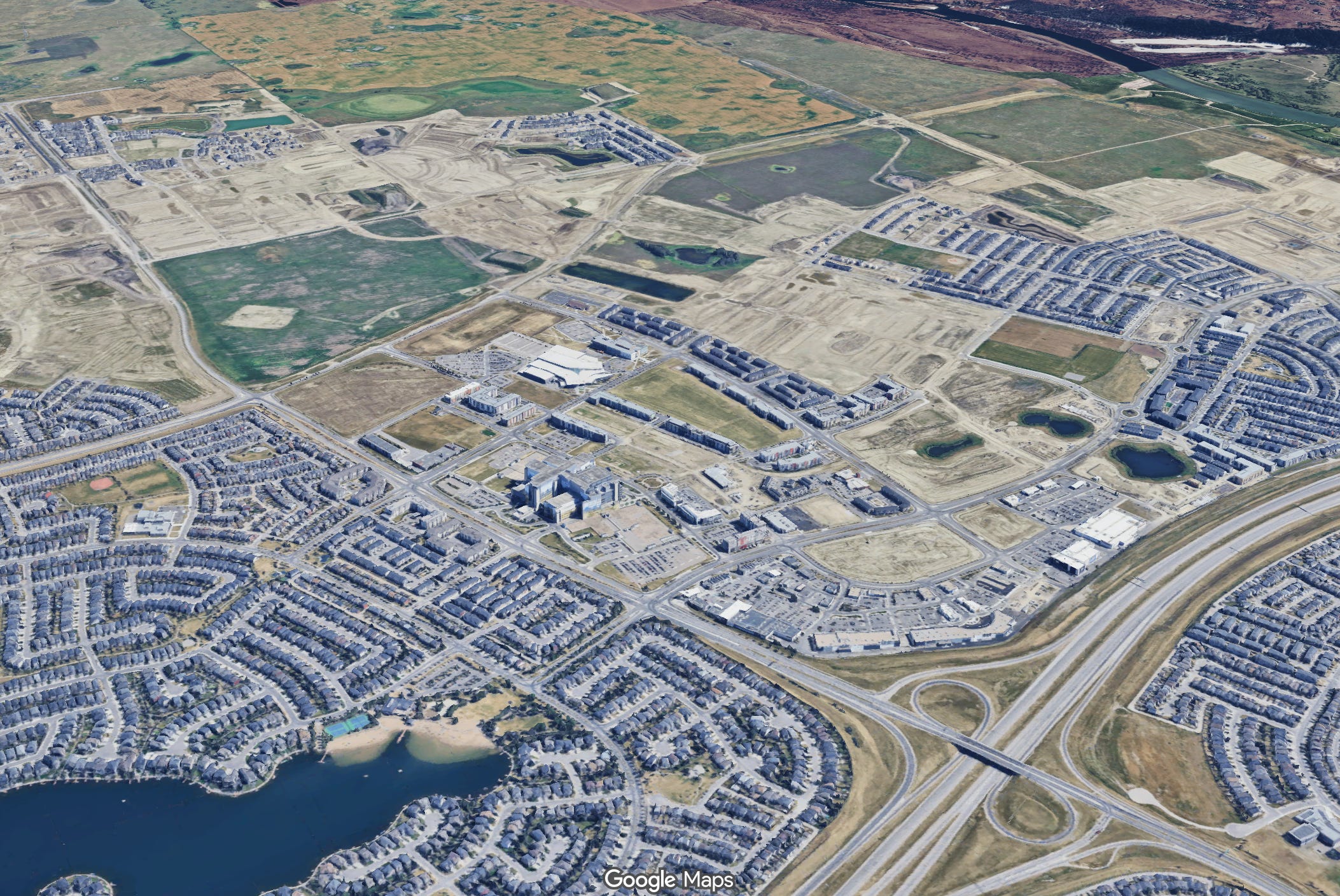
These suburbs are by no means perfect, but as Toronto with its greenbelt delivers new suburbia with no rail, services, or high density to be found, Calgary and Edmonton provided rail service right to the middle of their premier suburbs, with (admittedly sometimes strip-mall-like, but increasingly less so) retail and institutional uses near stations, and increasingly mixed-use development.
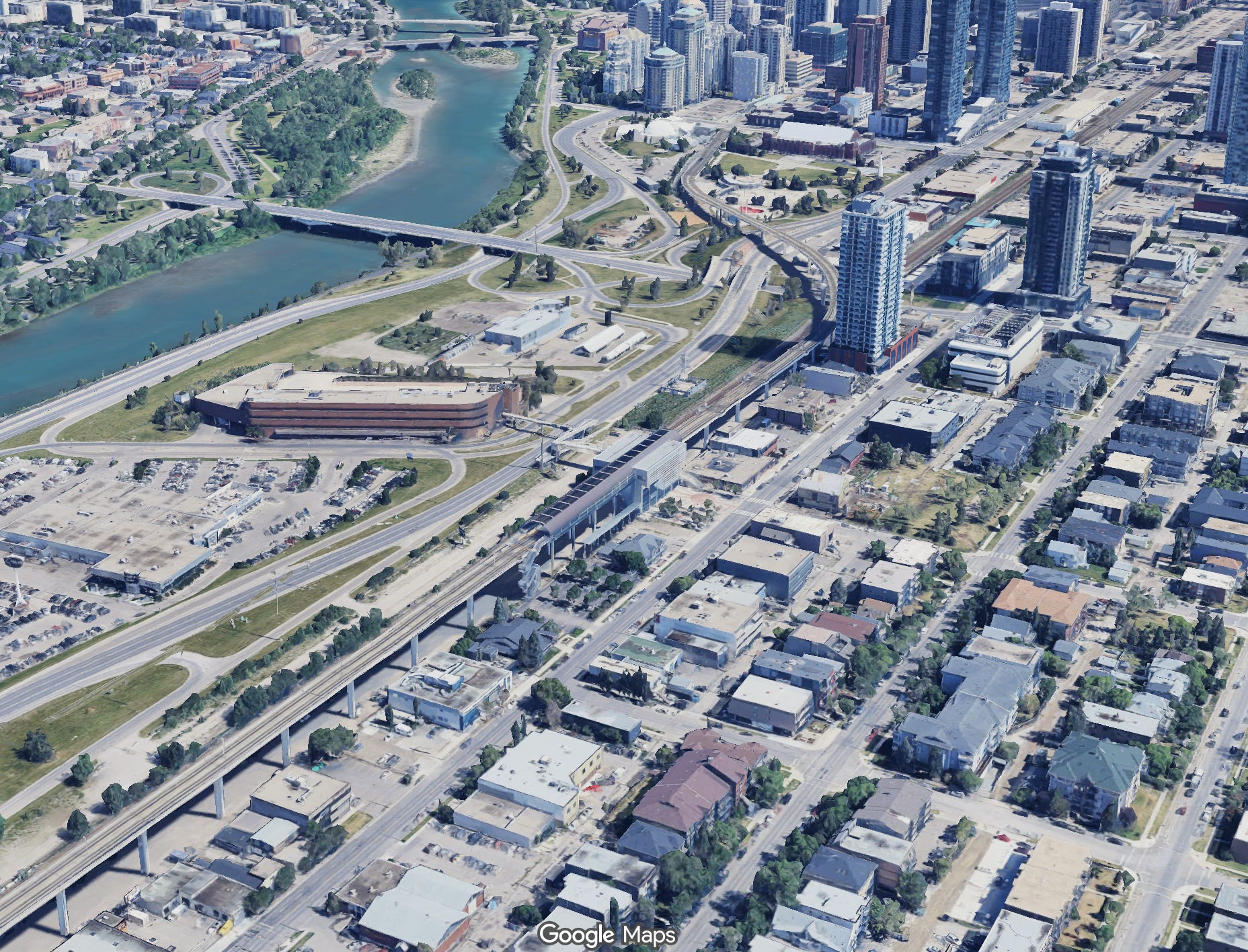
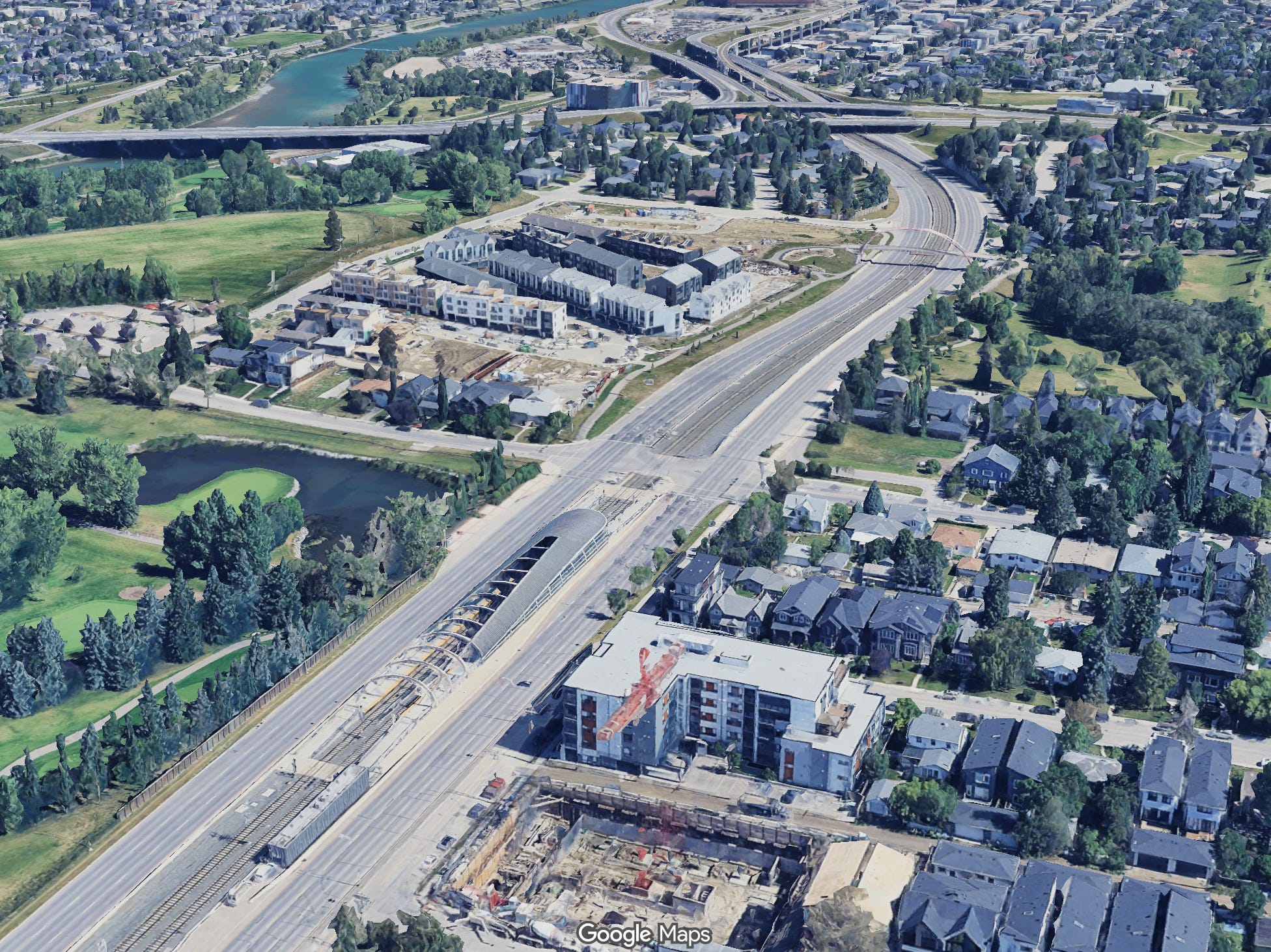
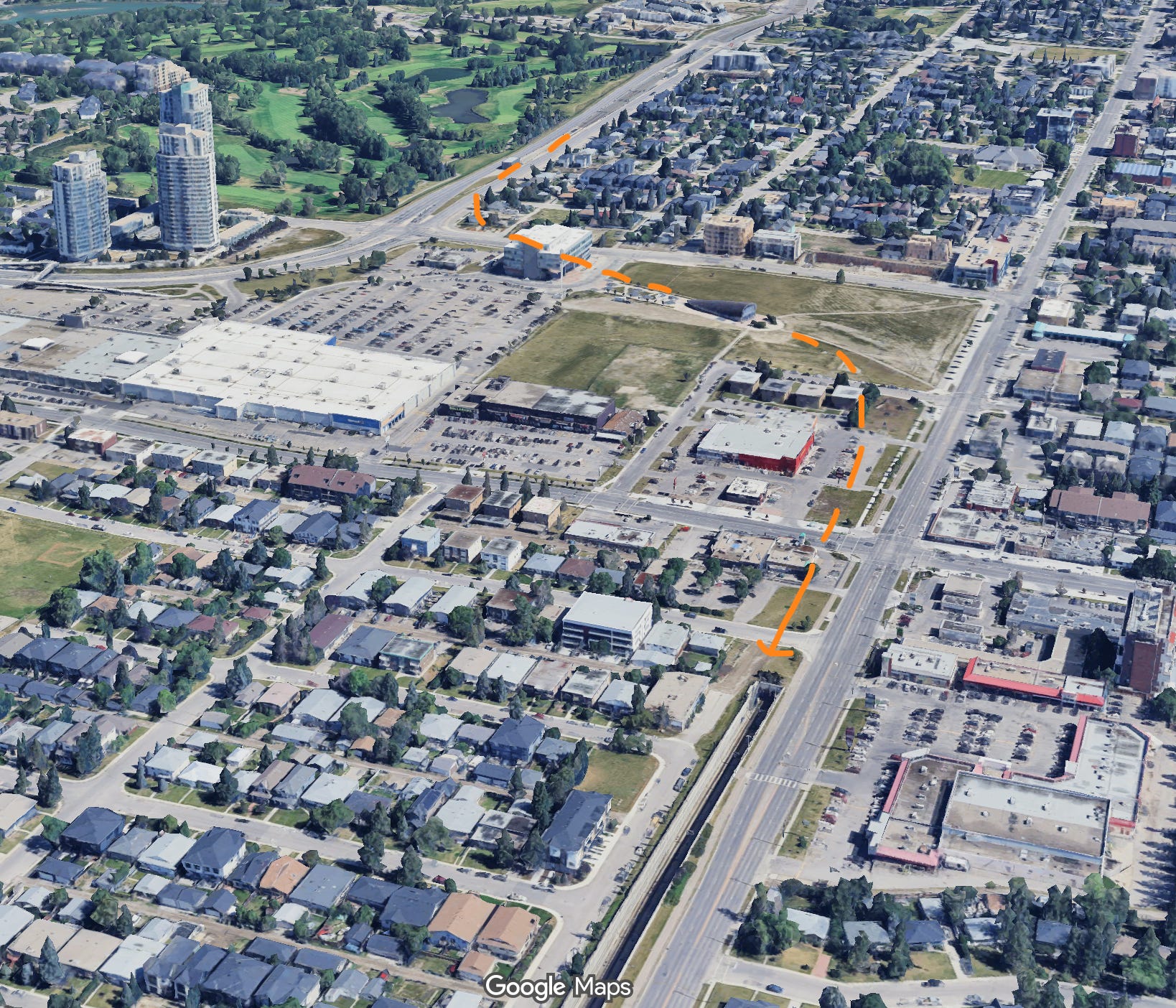
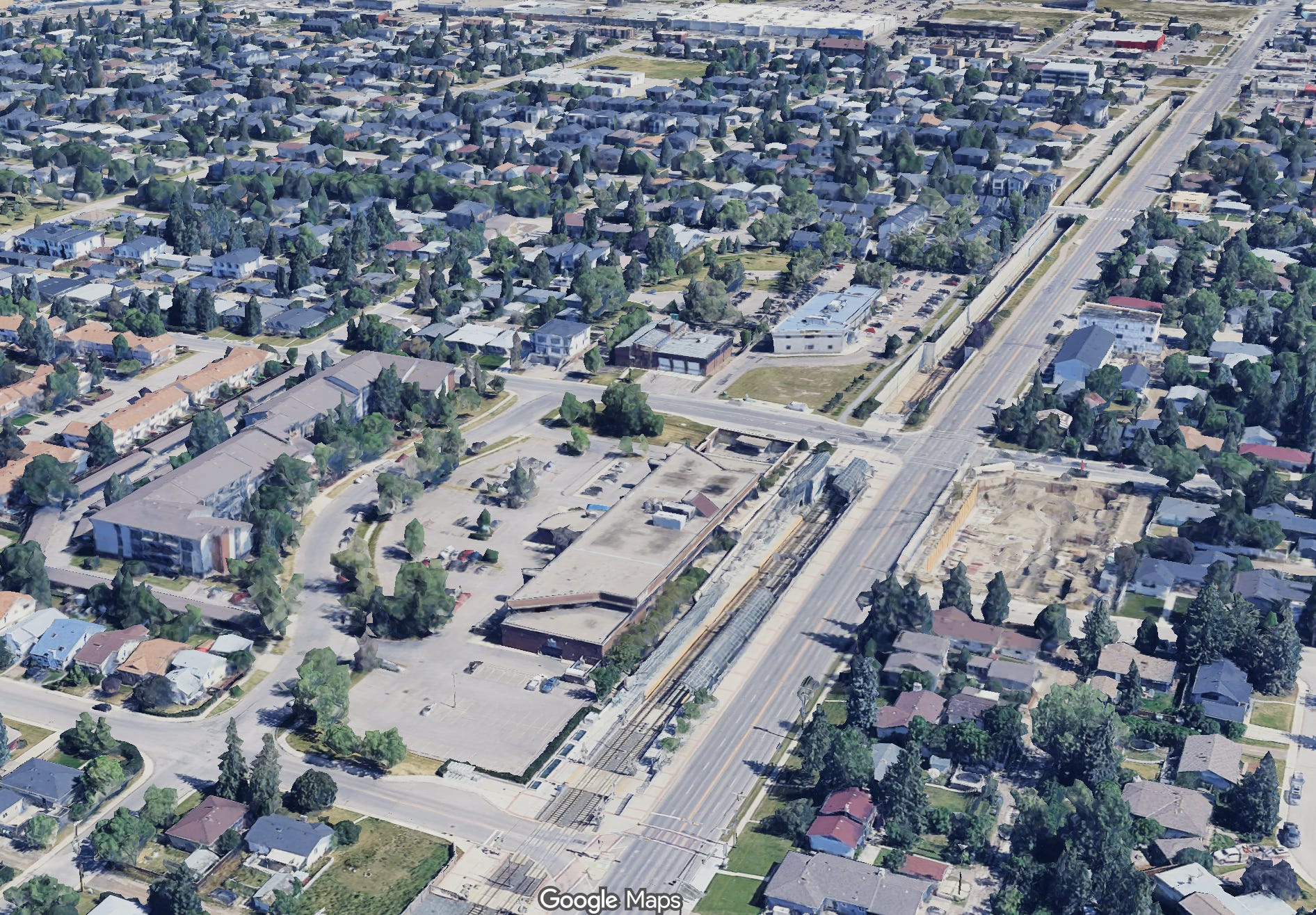
We’d argue the high water mark of Albertan rail development in terms of value — but also the beginning of a decline in cost effectiveness — was Calgary’s West LRT. This project came in at a higher price than your author recalled ($1.4 billion CAD for 8 kilometres), but a tiny fraction of going prices these days (Waterloo ION Phase 2 is projected to cost 30% more per kilometre for a system with ~50% of the capacity, and far less grade separation). We’d also argue that by some measures this was the pinnacle of Canadian efforts in providing remarkably nice transit at a reasonable budget and in only five years — a third the construction timeline of Toronto’s first real foray into modern “light rail”, with more capacity, and for less capital. The route for the West LRT was in our view a masterclass despite lacking total grade separation: there were level crossings, but with total priority and boom gates, as well as strategic grade separations to ensure speed and reliability. It is kind of like a higher-order form of the French tramway — highly dynamic and contextual, utilizing underground, trenched, at-grade, and elevated alignments. Let’s take a look in detail.
It’s elevated as it leaves downtown.
Then mostly uninterrupted in the middle of an arterial.
Then underground to jump to a parallel corridor.
The route remains in a trench just long enough as to not have level crossings on both sides of 45 Street Station.
Then more surface operation at the side of the road, meaning only two level crossings between stations.
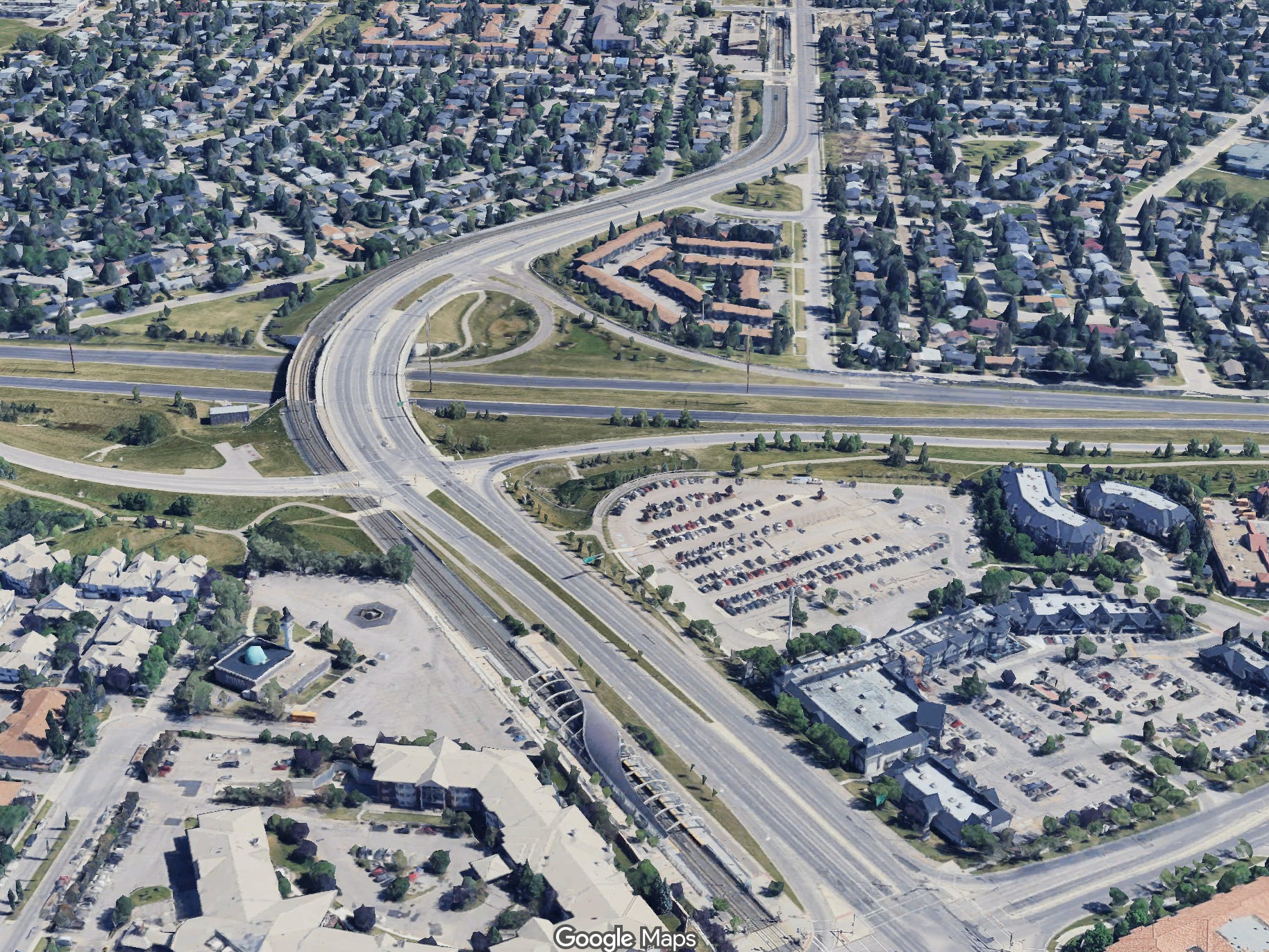
And then only two more crossings to the terminal station, which is also in a trench, and features a parking garage near the edge of the urban area (where some parking is sensible).
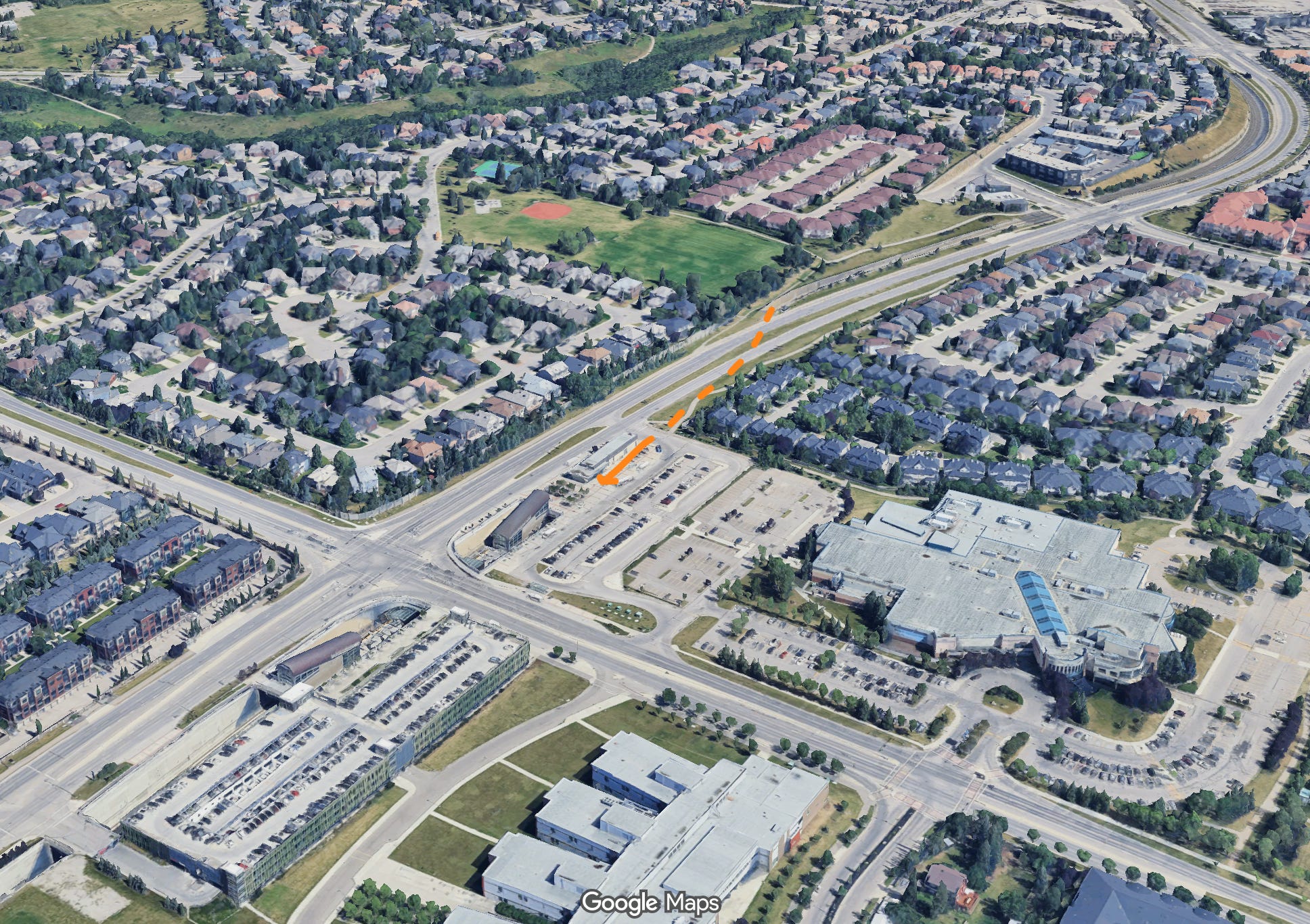
While German cities contend with very different built form and urban design, when building out their stadtbahn systems, the West LRT feels like what Stuttgart planners might build if they were airdropped into Canada.
Stadtbahn is an important concept here. These systems were and are a fairly successful attempt for German cities to get much of the benefit of a subway, or to comprehensively upgrade a tramway, without deploying huge sums of capital.
The stations also feel soulful, while the modern light rail we build often has all the charm of a parking garage.
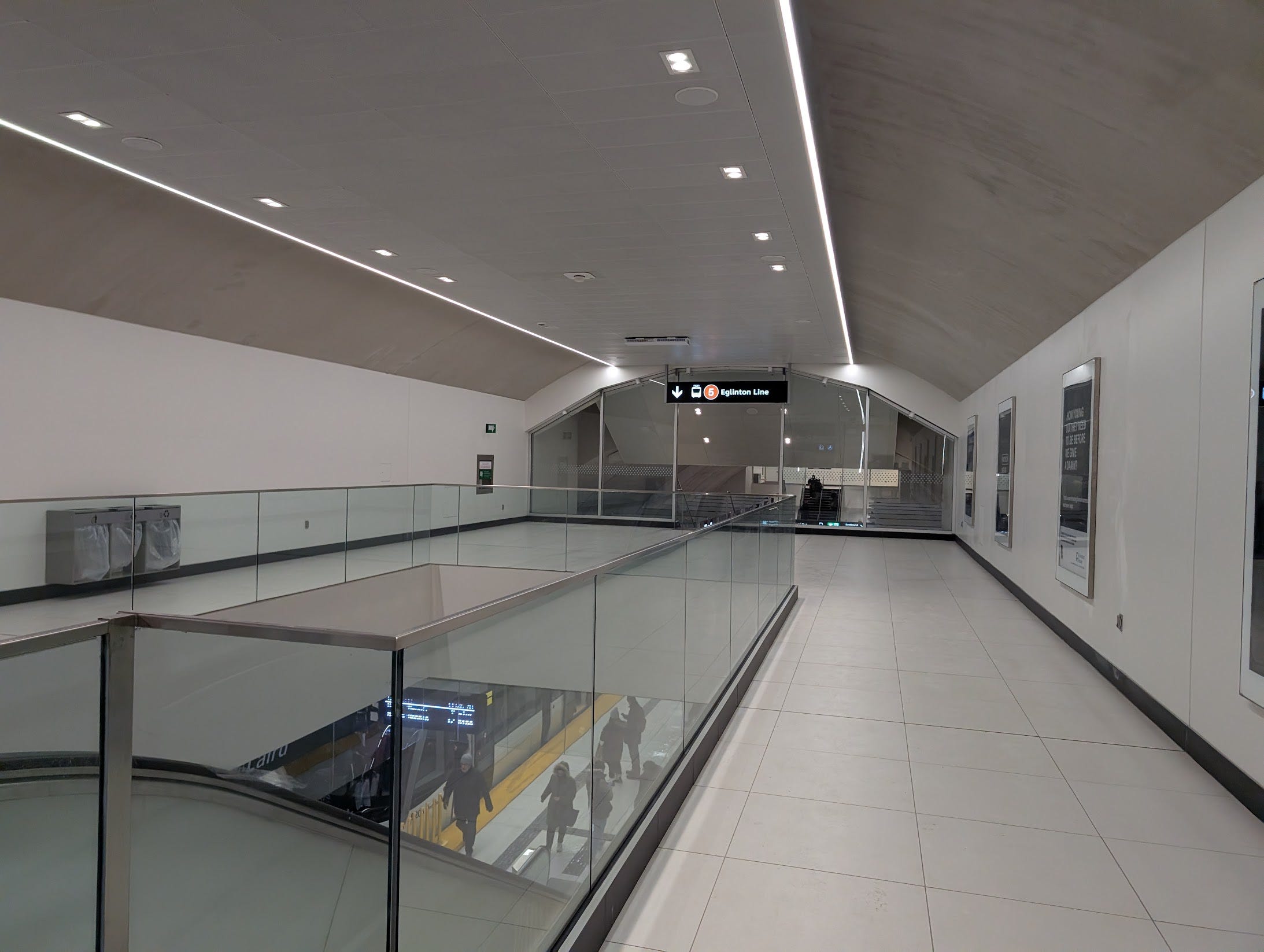
Meanwhile …
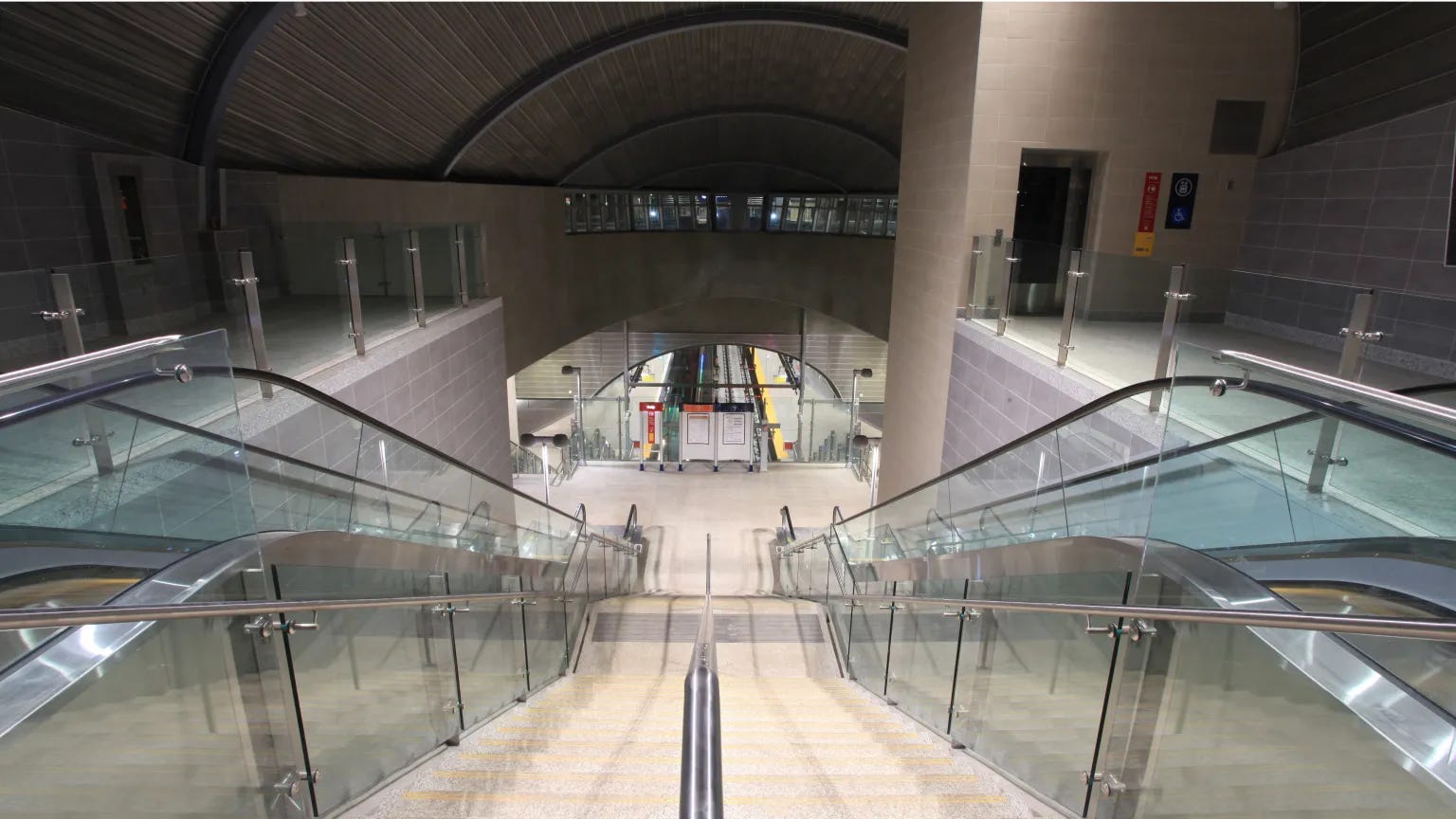
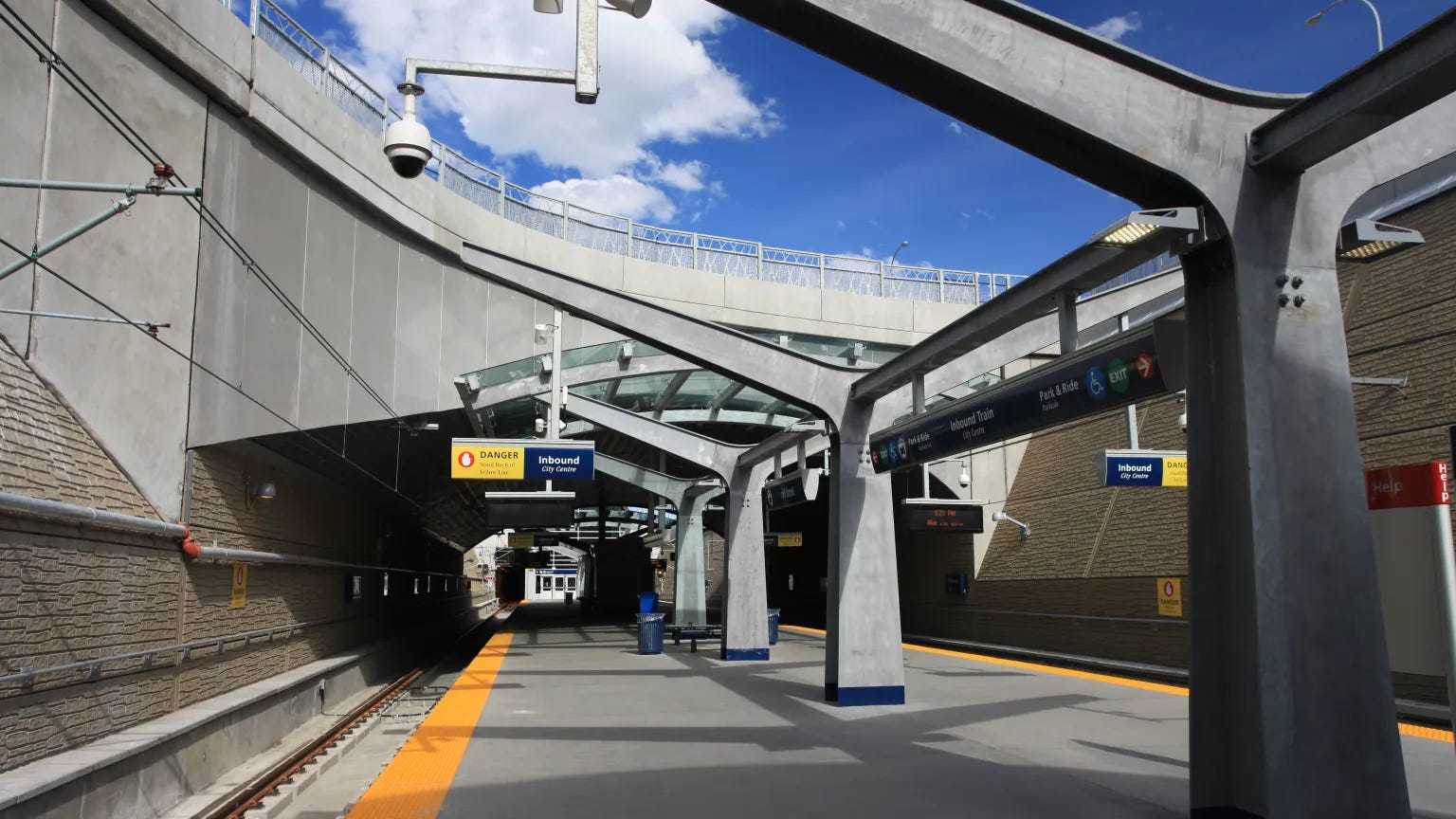
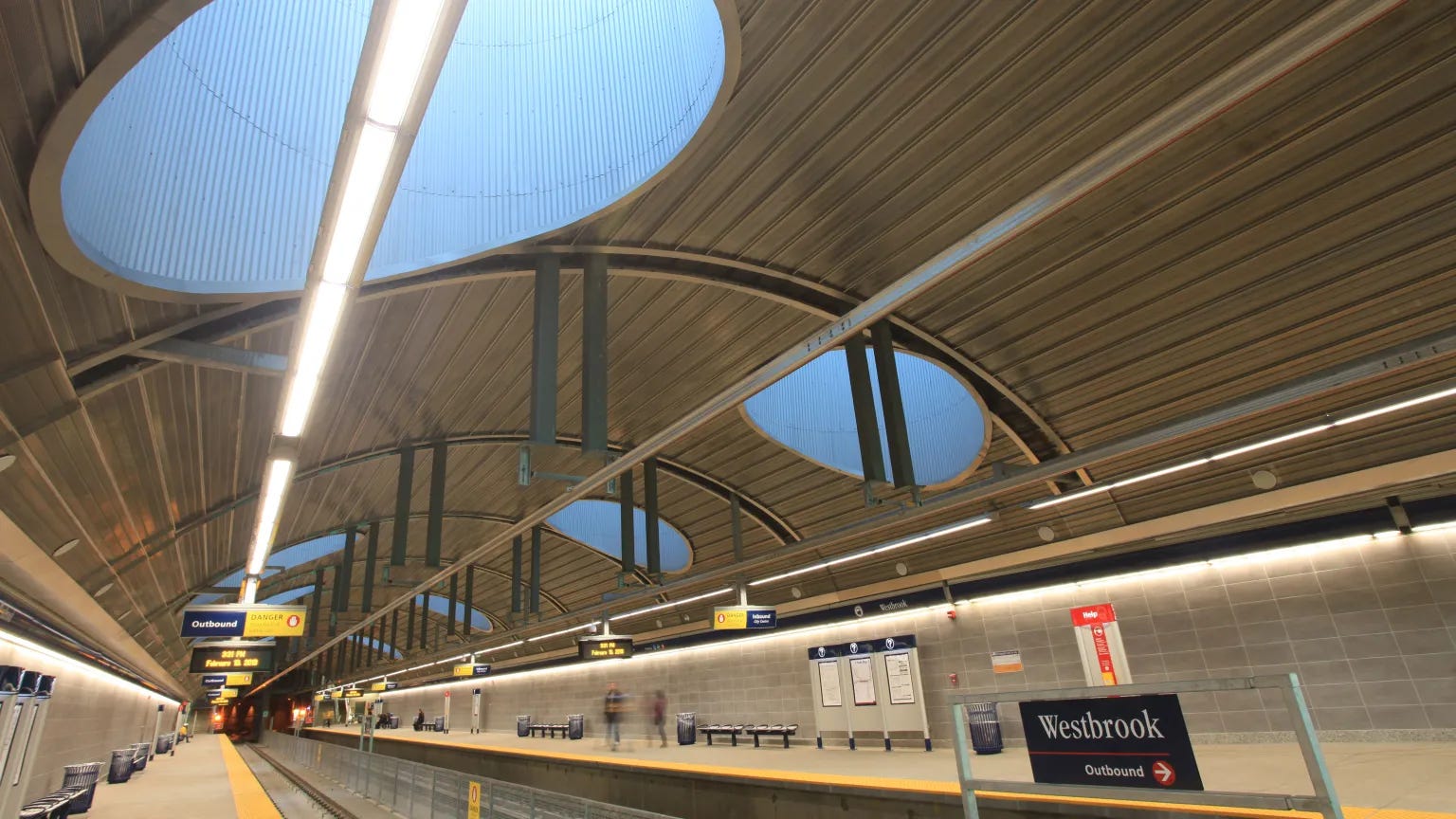
Now, thoughtful readers might question all the praise we’re throwing on this project given that it’s not a metro — it still has level crossings! This is a lot of fuss for something that can’t run every 90 seconds!
The thing is, the need for total grade separation is itself less total when you don’t need every ounce of benefit on the benefit side of the cost-benefit scale. Hyper-optimization is not necessary when you aren’t betting the farm. At the same time, Calgary has downtown level crossings, so the small number of new ones here don’t really add a novel challenge.
Suffice to say, the iron was hot for rail development in Calgary in the late 2000s.
How far we have fallen …
Don’t miss a single post. Become a subscriber today for the latest on public transport in Canada, and beyond.
The Fall … in Edmonton
The fact that something was really changing became most obvious with Edmonton’s Metro line project, which was just fiasco after fiasco. Let’s look at that.
The Metro line started from the very nice downtown subway Edmonton invested in early on — a move that Calgary still has not matched. Even the branching tunnel north of Churchill station was a vestige of that lost era, pragmatically built as part of adjacent skyscraper development projects.
Calgarians — who, instead of making this investment, grew out a larger network — turn up their noses at Edmonton, but as we will see shortly, Edmonton got the last laugh.
As if to make it especially clear the transition that was being made, after leaving the subway and serving the slick Rogers Place, the huge once-subway trains are reduced to plodding median trams. From Manhattan to the Spadina streetcar in the blink of an eye.
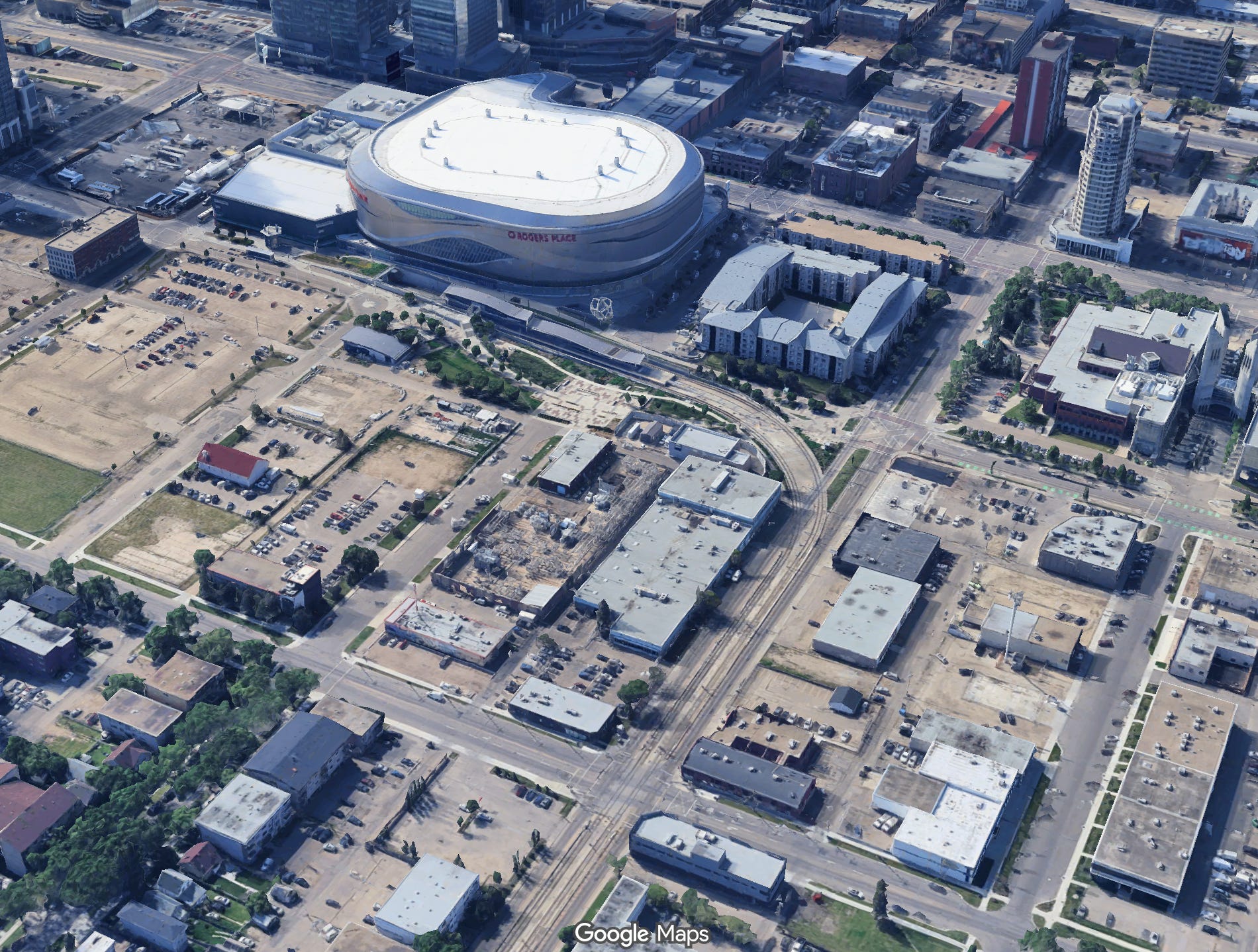
In Calgary on, say, the West LRT, this section of track likely would have remained below-grade or in a cut-and-cover tunnel; instead, we have several downtown-adjacent level crossings.
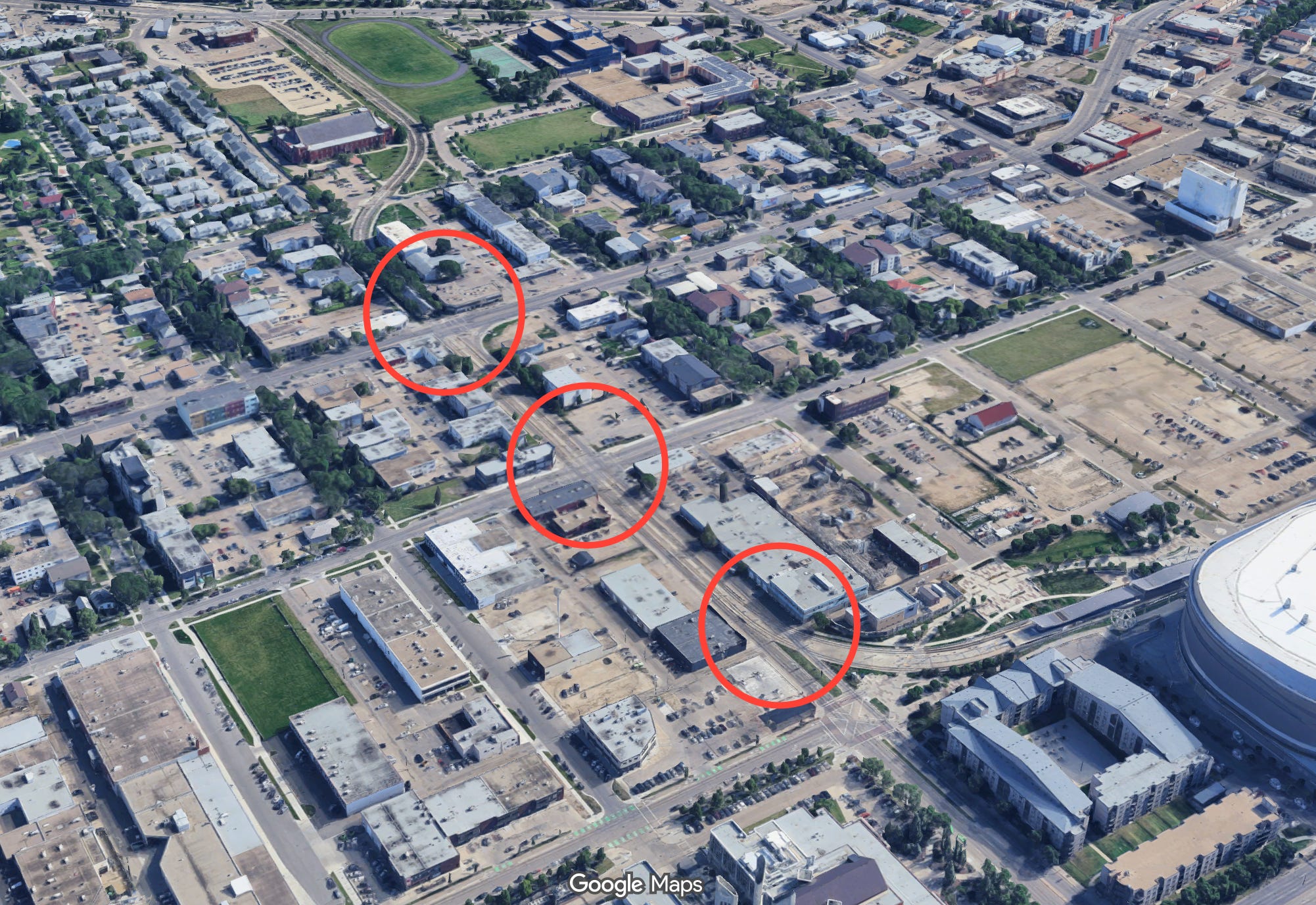
The route also suffers from a bunch of awkward level crossings, which are taken at low speed — increasing disruption to pedestrians and drivers — across fairly significant urban arterials. What’s worse is that the at-grade stations lack indoor underground connections to the major hospital, mall, and college near them, making trips longer and transit less convenient, especially in the brutal winter. This forces riders to cross those wide streets, mixing with trains and traffic. It’s almost as if you asked a traffic engineer to design something that would cause a traffic jam — a plague in the city’s arteries.
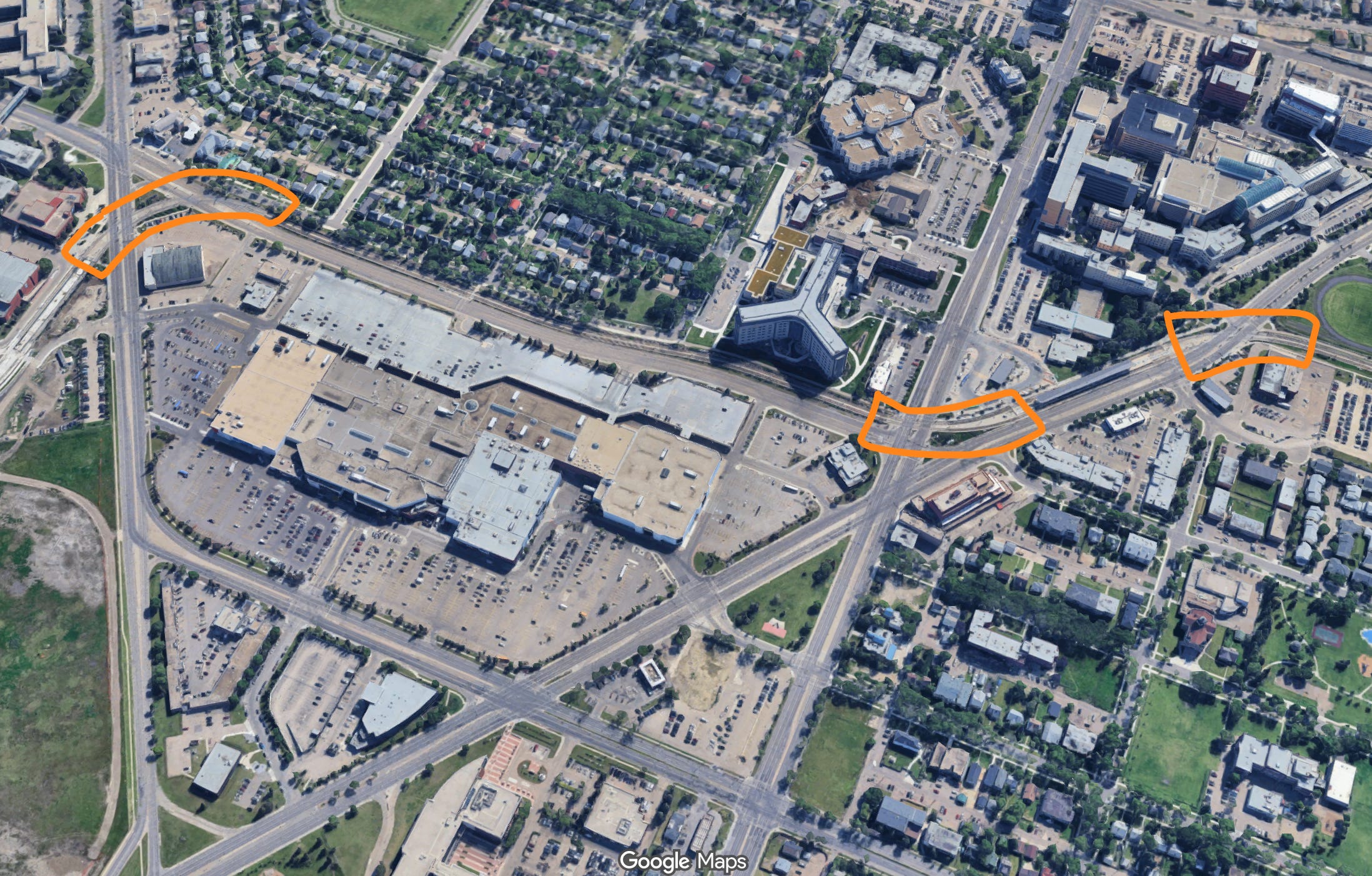
You can really tell that things have not gone well, because less than ten years after the line opened — and with both lower frequency and shorter trains than it will one day have (thus lowering the impact at crossings) — expensive grade separations have already been discussed.
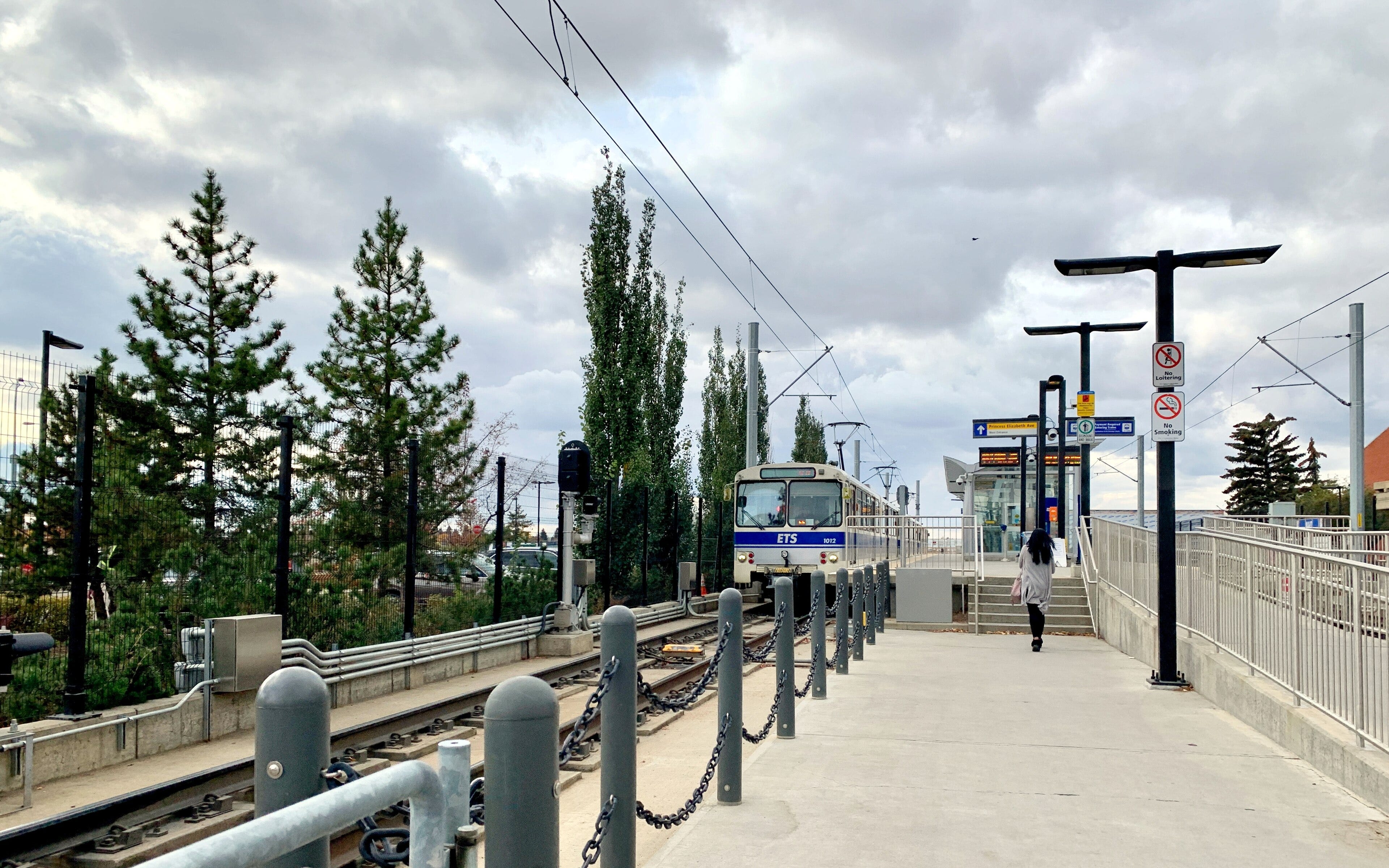
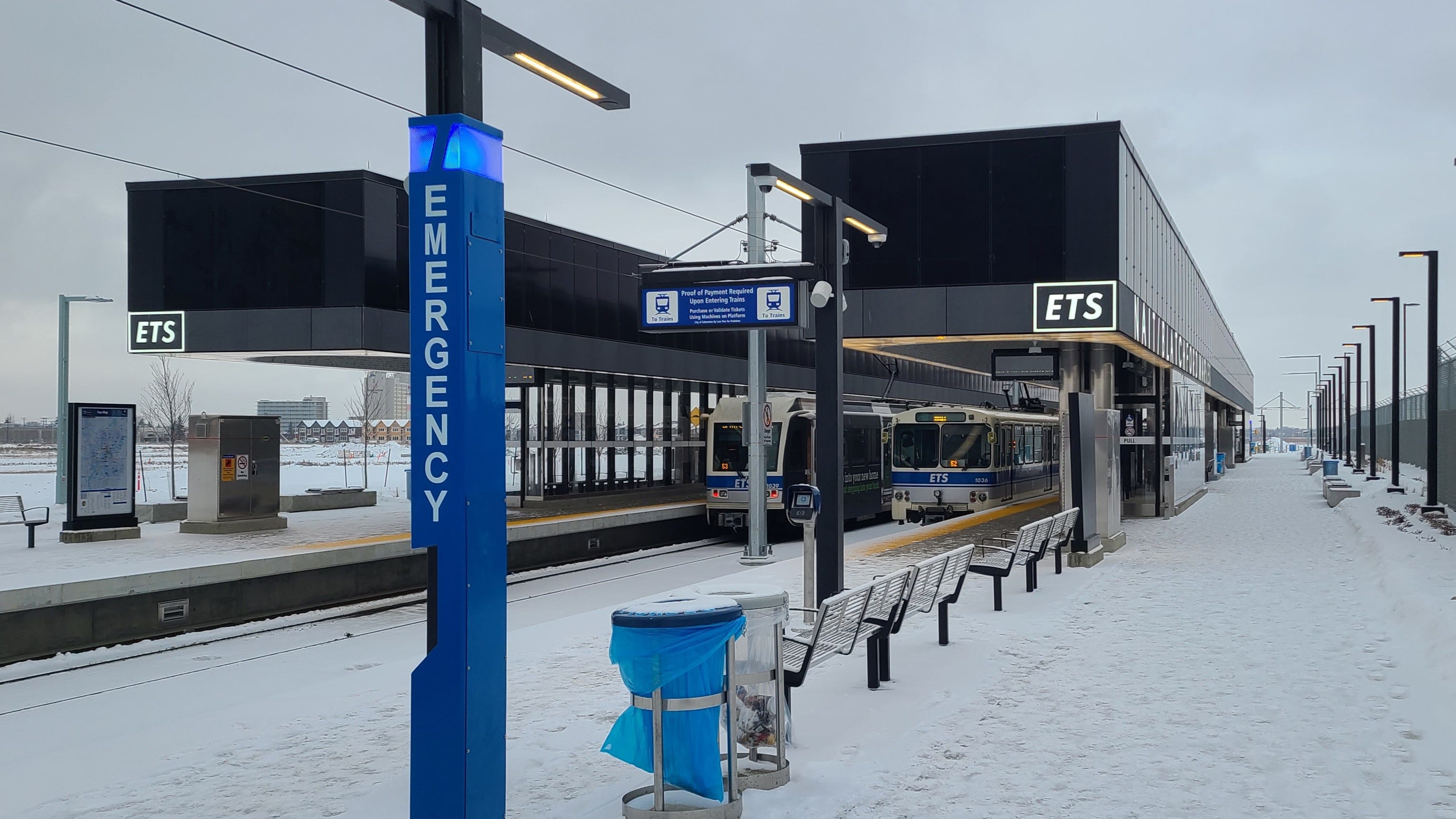
What’s worse is that the line’s extension north, which includes two new stations and thankfully no major crossings, created an entirely different problem. In order to minimize the “visual weight” of the overhead power system — an entirely aesthetic concern — this new extension has a single overhead contact line tensioned by the trains, leading to frustrating speed restrictions. At The Transit Brief, we support more visual considerations for transit infrastructure, but not when it means making that infrastructure obviously worse.
The following photos show the two overhead line systems, and the visual weight that was avoided for onerous speed restrictions.
As it turns out, basically all of these — mostly negative — changes come back to a concept that planners and officials refer to as “urban LRT.” The concept is honestly a bit incoherent, but appears to be the result of a desire to make Edmonton’s light rail, which is closely related to the German Stadtbahns, more like a lightweight tram or streetcar. Fewer tunnels and underpasses, more people waiting on platforms next to roadways, filling sidewalks, and electric trains snaking through a street grid on the surface.
This instinct isn’t necessarily entirely crazy: the way light rail was deployed in Edmonton, with larger trains than you’d generally see in Germany and alongside wider streets, can feel a bit pedestrian-hostile and doesn’t exactly make one feel like they are in Paris or Milan. However, the aggressive avoidance of intersections and overhead and underground connections to stations are not aesthetic; they are functional design choices. If anything, a greater degree of separation, making the system more like a subway, would be reasonable. Trying to contort this higher-capacity transit to emulate the function and aesthetic of a form of transit that we ripped out (not entirely without reason) — the streetcar — for reasons of appearing more urbane actually hurts the thing that matters much more for good urbanity: fast, frequent, and popular transit.
Valley
The Valley Line, Edmonton’s latest, suffers from many of the same problems. While the new low-floor trams now look like they came from Europe, the reality of the size and sprawl of Edmonton forces them to be coupled up into giant, nearly 100-metre-long units that lack the quaint aspect of a tram running through old European city centres, and can feel a bit more reminiscent of a freight train crawling through town as they lumber by.
Now, the line itself is a bit more attractive and sensible. The stations stand out less with their platforms barely above the curb, and the street design has trains closer than ever to cars and pedestrians, sometimes with narrowed streets. However, the cost of this and the avoidance of traditional railway boom gates with bells means slower service and more near-misses and collisions with cars — making transit prettier, but less reliable and competitive.
Boom gates are sort of ugly and loud, both literally and visually (we could adopt less ugly designs from overseas, but alas), but the fact that they come down and physically block traffic means trains can act like nothing is ever going to be in the way and speed along. The modern trend of traffic lights keeps train drivers slower and on edge, and appears to lead to far more collisions.
The Valley Line also does not totally lack the crazy intersections with roads that would never exist near a contemporary tram in Europe, or the sections of grade-separated track needed to navigate a city that has not had streetcars for a long time.
A frequent problem for contemporary light rail in Canada is that planners seem to be able to grab hold of projects and shape them largely as aesthetic components of an envisioned Europe-esque urban form, while ignoring their transport function — compromising speed and often cramming in too many stops, which are great for selling transit-oriented development. Claims that more stops improve local “access” are rarely weighed against the obvious reduction in “access” created when transit is so slow that fewer things are within a reasonable travel time. Combined with poor frequency — a recurrent problem in Edmonton, which any transport planner worth their salt knows is the lifeblood of transit — these systems are just not great ways to get around.
Worse still, these same planners often struggle to understand that similar systems in Europe would not be bogged down by these compromised functional transportation elements, but also would not be in a dance with six- or eight-lane roads, or leave their riders at attractive stops ... at the side of vacant lots or parking for the first three decades of operation. If you cannot get community buy-in for all these things, this may not be the ideal transit solution — the lack of trams in Asia, we think, reflects this pragmatic logic.
The result is that the Valley Line, while obviously more comfortable than a narrow, bouncy bus, is not always consistently faster than bus options (a common affliction for light rail in this country), and has attracted disappointing ridership — just 10% of overall system use despite being close to 40% of the system’s length.
So then, Alberta went from building architecturally interesting semi-metros to a poor emulation of Europe that doesn’t just fail to beat the car, but also the bus, in a span of just about a decade. Planners seemed to forget that what really makes transit beautiful is not its positive aesthetic characteristics, but its ability to quickly and efficiently move masses of people, notably allowing cities to avoid ugly car infrastructure.
Some comparisons have suggested that the Valley Line is better conceived than the Finch West LRT in Toronto, but that’s a bit like saying the Chevrolet Blazer (famous for rollovers) was better conceived than the Ford Pinto (famous for horrible fires after collisions).
Don’t miss a single post. Become a subscriber today for the latest on public transport in Canada, and beyond.
Meanwhile, to the South
While Edmonton was busy building what are arguably the wrong things, Calgary was simply not building. In the nearly 15 years since Calgary opened the West LRT, no new project had even started until the last few months with the Green Line.
This delay would be bad enough by itself, but a real win for transit in the Trudeau era was plentiful federal funding for new transit — funding that kicked off building booms in Vancouver (where two major, long-planned SkyTrain projects are underway); Edmonton and Ottawa (cities which had much smaller rail systems, but are now close in scale to Calgary); Montreal (which built a new regional subway larger than Calgary’s entire existing rail network just in the time since Calgary’s last rail project opened and while its next project has been debated); and Toronto (which will have likely added as much subway as Calgary has light rail in these intervening years).
Calgary in the early 2010s had a huge advantage: rolling, cost-effective, and functional rail expansion, and a transit system that punched way above its weight. It has completely wasted and lost that advantage, with its biggest transit initiative of the last decade being a disappointing bus project — the Max “BRT.”
What is so frustrating is that this was not inevitable. Near the end of the Harper government, Calgary was advancing plans for the “SETWAY” or Southeast Transitway, a busway that would be designed for eventual rail conversion, as in Ottawa. The election of the Trudeau government was initially a boon here: the in-between busway stage was dropped and the money was there to do rail from the beginning — this was the Green Line.
However, the Green Line is only finally starting to get seriously going, probably a decade after it could have. The reasons for the delay are many.
For one, the project was — like Edmonton — to use low-floor trains. The idea here was definitely shaped by an “urban design before transportation planning” approach, largely driven by a desire to create a certain type of urban street environment on the route along Centre Street north of downtown Calgary — a Spadina Avenue of the West (a broad avenue in Toronto with a median streetcar), if you will.
We recall public meetings where interested city councillors suggested the Green Line “had” to be different: existing sections of C-Train ran down the middle of highways (this is true, though it was also not a natural option for the Green Line), and had high platforms that stood out like a sore thumb (this is kind of true, though cities in other places manage to have high platforms for trains along urban strips that are perfectly pleasant). Thus, the Green Line would be like a European tram, winding through the city around roundabouts and such (there are no roundabouts on the route).
To the chagrin of these advocates, a series of technical advocates (a bit like one might experience in Germany, honestly), comprised of engineers and concerned citizens, put up a real fight about abandoning the old style of trains Calgary had used for new low-floor ones. Some of their arguments were off the mark: while you could share things like yards with the older lines if you had the same type of trains, the reality is that functionally speaking, Calgary already had too few yards, and ideally you want a yard for each line, on each line. But at the same time, they did have a point! The C-Train model as it was worked well, using a common standard would probably be more likely to keep that legacy going, and there were still in truth ways that a unified system would help save money, like larger fleet procurements.
To add to their point, while the case for low-floor trains on Centre Street does make some sense, the part of the line that actually had a prospect of being built in the Southeast was a shoe-in for a design highly separated from roads, like the West LRT. Furthermore, the plan for a downtown tunnel would be much more expensive for the longer, lower-capacity low-floor trains on the line.
Since low-floor trains have a lower capacity-per-length because of a lower standing capacity driven by the intrusion of the wheelsets into the cabin, the stations would have had to be bigger. Initially, Calgary planned for the line to have what would likely be the longest low-floor tram consists ever used in the world, at something like 150 metres — ~50% longer than those on Edmonton’s Valley Line — as a futureproofing measure as the Green Line grew very long, extending into the city’s sprawling suburbs.
Suffice it to say, the line using low-floor trains — when these would have significant cost implications, encourage less-functional corridor design, and not even see their natural application running up a road median until some untold future date — felt like the tail wagging the dog. They were the perfect thing for a project the city was not building, though changing things is no longer in the cards. The city placed an order for vehicles from Spanish trainbuilder CAF some years ago. Sadly, the diamond-in-the-rough, forward-looking super-long trains were cut as a cost-saving measure, meaning the once-excellent foresight in Alberta rail planning was clearly eroding.
All this battling ended up slowing down the project, which made it more expensive, cost Calgary more funding, led to expensive designs and redesigns, and also meant delays and enormous inflation inflicted by the COVID-19 pandemic that might have otherwise been largely avoided.
Tunnel Troubles
Worse still, the downtown tunnel created a number of issues. Calgary’s soil is not ideal for tunnelling through (though it’s clearly not literal mud like, say, Shanghai — a city with more subways than all of Canada — so these concerns do seem out of line with reality), and so that has been a recurring theme. Initial plans with long trains also came with large, almost excessively large and opulent underground stations, which would likely have cost a lot.
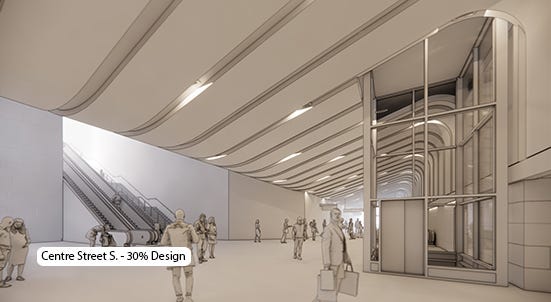
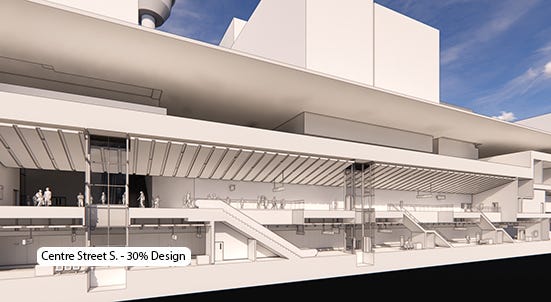
The cost and problems with the tunnel meant endless back-and-forth and plan revisions with different routes and designs. There were also concerns with how the route might ultimately leave the tunnel and the surface impacts it would have, as well as with where a new downtown arena might go and how the Green Line might best serve it — not to mention ever-rising costs. These were all a major source of delay.
As we see it, this was all a bit silly. The Green Line probably should have been high-floor, but if it was to be low-floor, then a tunnel would be either expensive (if long trains were used) or wasted (if short trains were used). The most sensible thing to do would be to get to the Edmonton layout, where a tunnel carries the high-floor trains, which best use the capacity of the tunnel, and the low-floor trains — optimized to pick people up from the curb — actually operate along downtown streets. The natural thing to do to achieve this would be a little swap. That would let Calgary fix its downtown transit mall — which works, but is ugly, with every other block being a high rail platform for the trains — by burying the existing Red and Blue lines in a tunnel. That project would be made somewhat easier by some provisions made in downtown buildings, and by the fact that unlike Edmonton, Toronto, or Montreal, Calgary has its downtown enclosed pedestrian network — the +15 — elevated above the streets, reducing potential conflicts.
The issue is that this plan would probably cost more than just tunnelling the Green Line, but not much more, and would have significantly more benefits (for all our obsession with cost-benefit analysis in Canada, it is often applied narrowly). This would have meant accepting that building a mass transit network for a city is not always best achieved by wrapping an atomized project up in a bow. As seen in many cities, sometimes trading space — or literally tracks — leads to a better outcome and a lower overall cost. This, however, was not really in the cards in the contemporary era of P3 project design and delivery, heavily pushed in Canada while the Green Line was being developed — which likely also would have derailed plans to somehow interoperate with the existing lines that the technical advocates wanted. Ironically, this is another reason those folks, even without realizing it, might have helped save costs by avoiding a P3.
The latest phase of these battles and machinations is a provincially imposed plan to instead elevate the Green Line through the dense downtown of Calgary. This plan may well save money compared to tunnelling today, but seems likely to be shockingly ugly, and truly the type of infrastructure that one would never expect a wealthy, developed city to go for. It also ironically introduces conflicts with the +15 network, and probably means a permanently worse route through downtown. We like elevated rail at The Transit Brief, but this is not the way.
High Concepts, Low Discipline
The imposition of a worse elevated plan through downtown Calgary — which somehow feels more absurd given it is being used for trams, chosen because they look nice when running on the street — is perhaps a lesson for us all. You can create a great plan, but if it is so slow or expensive that the political level won’t fund it — or if the political level is overly slow and conservative with funding — you may suddenly be forced to accept something much worse than if you’d compromised more, or been more pragmatic upfront.
But this also isn’t really the result of competent policymaking.
It is basically the case that because the Green Line tunnel downtown got so expensive, the province decided to dictate that it had to be above ground. But this didn’t happen because the province decided that it was the right way to send a message to a wayward city. Many of the delays on the Green Line come down to on-again, off-again funding from the province, or imposed reviews and the like. Had the project been driven forward to take advantage of federal money years earlier, you probably could have gotten the bigger tunnel for the same price as the elevated alignment might have cost. Sitting on your hands is not free, or good policy. Forcing a less-nice project that is less locally popular is an interesting fiscal enforcement mechanism — less so when the costs and delays are half on the enforcer.
The masterplanning work Alberta is doing is absolutely good. But does the same government so willing to come in and completely change a project being developed by a city think that its designs will actually be followed? A masterplan is worth much more if it’s actually largely adhered to; without that, it might be a net negative in slowing projects and spending resources. The analysis paralysis they have contributed to in Calgary does not bode well.
There’s also the issue of getting specific. Albertan cities were historically good at setting aside land for future rail, and this would be great at a provincial level. A masterplan which mostly just says “we will connect big cities together, and smaller cities to big cities” does not get us there.
The various private projects in the mix really do make things feel like the Wild West: from “Prairie Link” high-speed rail, to rail from YYC to downtown Calgary and Banff, to a “hyperloop” (still not a real technology) being proposed on the outside of the masterplan. This does not help matters, and makes it unclear how serious the masterplan even is. Will these projects happen? While it’s great that there is interest, it’s hard to say. At some point, politicians need to realize that a project funded even in part by others is rare, and that a project is generally better than no project (which is the status quo for most of these lofty aspirations these days).
Spot checks for rational decision-making also turn up bad. For a while, “hydrogen rail” — a former silly obsession in Ontario — was hot in Alberta, largely as a cynical attempt to create a new market for the fossil fuels Alberta continually fails to diversify away from. Unfortunately, an alternative fuel that isn’t going to save Alberta’s energy industry is doubly sure to not save transportation (there are a small number of hydrogen train projects globally, interest is low, and projects have consistently been abandoned). The last thing we need in Canada is energy and vehicle availability to somehow make planning projects even harder.
At the same time, a constant pipeline of projects in planning and delivery is critical, and somewhat absent. While Alberta’s government talks a lot about extending the C-Train to the Calgary Airport, the project — which is basically trivial — has gone nowhere. In the time it’s been seriously talked about, Ottawa and Montreal will have christened their own airport rail link trains, and Toronto will be working on its second. Alberta has traded regular, cost-effective, and well-conceived projects that were actually delivered for “plans” which are not. While masterplanning is good, given the experience in Edmonton, better planning and design seem like they may be even more important.
It all leaves us feeling like Alberta’s housing market is a good parallel. Homes in Edmonton or Calgary are a fraction of the price of Toronto or Vancouver, which is a huge win; however, this was largely achieved through mostly unchecked sprawl and disorganized processes. No doubt there are some good things happening as well — mixed-use suburbs with a variety of densities as discussed above — but Alberta has (largely, and historically) not delivered affordability through concerted efforts unlocking challenging policies like building code reform or massive rezoning (Calgary is busy rolling one back, actually), but through simply regulating less. That approach just won’t work for transport, where coordination is key.
Bring the Fix In
Alberta fixing the situation means recognizing what it used to do well. Incremental transit builds in Edmonton and Calgary could — in time — deliver rail to each slice of each city if a mind is paid to low costs, smart design, and consistent building. Setting aside space to put tracks, and clearing the path of utilities and structures, would double down on smart decisions made in the past. Cities know where they are going to grow; setting aside space, and sometimes even constructing things like bridges or short sections of tunnel when a neighbourhood is built, could give you better infrastructure for less. These ideas have been experimented with, but not enough.
But some things also need to change — as the cities grow, old lines need to be upgraded, infrastructure needs to be replaced, and tunnels are sometimes necessary. You can’t expect transit to always subsist on limited funding and small projects; growth can’t always pay for growth. It is often the surge of riders, or of solved problems that come with a big project, that enable another period of slow, methodical building, and projects like orbital rail or BRT that will one day make sense are unlikely to be funded by distant suburban growth.
Standards, which should exist on a national scale, could help make the decision-making process more streamlined, keep everyone honest, and help reduce costs. For example, determining what type of train technology is used could be based on the length of a line and average speed; traffic numbers could decide whether a level crossing in a particular place is okay. Procurement of trains and other equipment and material should be done in bulk, possibly in collaboration with other provinces — this is made much easier when the same train that works in Toronto also works in Calgary. The responsibility for standards like this ought to be passed back to the federal government, which funds projects, but doesn’t get a lot of say in how they are managed.
For Calgary, no amount of plans will fix the fact that the city just isn’t getting transit built. The reality is that no project is perfect, but that incremental improvement — the only reliable path in that direction — is only possible if you actually have something to increment on! Transit building is a process of experiments; not everything is an overnight success, and the only real way of knowing the value of projects is building them, and then adjusting.
For Edmonton, serious soul-searching is needed. New projects have been expensive and less forward-looking. We need more “let’s build a subway for downtown” and less “let’s put tracks across two heavily trafficked urban arterials.” The city needs to recognize that the outcome of good transit will be pleasant urbanity; transit, like sewers or power lines, should not carry the weight itself of bringing about a prettier city.
The Alberta government needs to understand that while pressing pause is sometimes the right decision, and one that can control costs, this is not always the case. When the federal government is being generous with funding for transit — arguably one of the biggest things it can do for Alberta — the province should really take maximal advantage. Planning is a great idea, and planning for central station hubs in the cities in particular, but planning cannot get in the way of continual building and learning, unless there is a real concern that a build will make some other planned initiative impossible. You need to manage the dance of following plans where they make sense, and diverging as conditions change and new evidence emerges. Having transit be early is also key to making it successful. Calgary and Vancouver both did big airport expansions in the early 2010s; Vancouver’s came with great new rail transit, while Calgary still hasn’t even broken ground on this, hurting its status as a major hub. Finally, the idea of a mechanism to make locals bear the costs of local transit decisions that create delays or increase costs is interesting, but doesn’t work if the province is the one creating those delays or increases.
We remain optimistic about transit, especially rail in Alberta, but for now, the province has a lot of catching up to do.
Keeping abreast of the transit networks across all of Canada’s big cities takes a lot of time and commitment. The Transit Brief lives and dies by your support. To receive new posts and support my work, consider becoming a free or paid subscriber.
Thank you.
If you enjoyed this post, consider sharing “The Transit Brief”.
Made with love, in Canada - 2026.