

High-Speed Rail and Canada's Lost Conservatives.
A sad pairing.

Canada’s High-Speed Rail project — Alto — is a bit of a mess.
The Liberal government —which is still in power today — started off with a plan called High-Frequency Rail many moons ago, which was a sort-of sensible, incrementalist plan to get VIA trains between Toronto and Montreal, which were growing in popularity onto their own dedicated tracks, possibly with electrification. This was meant to be a rational, cost-effective plan that would make trains more consistent, frequent, and ultimately fast — a triple threat for intercity trains that could already be compelling if they weren’t so expensive, unreliable, and infrequent.
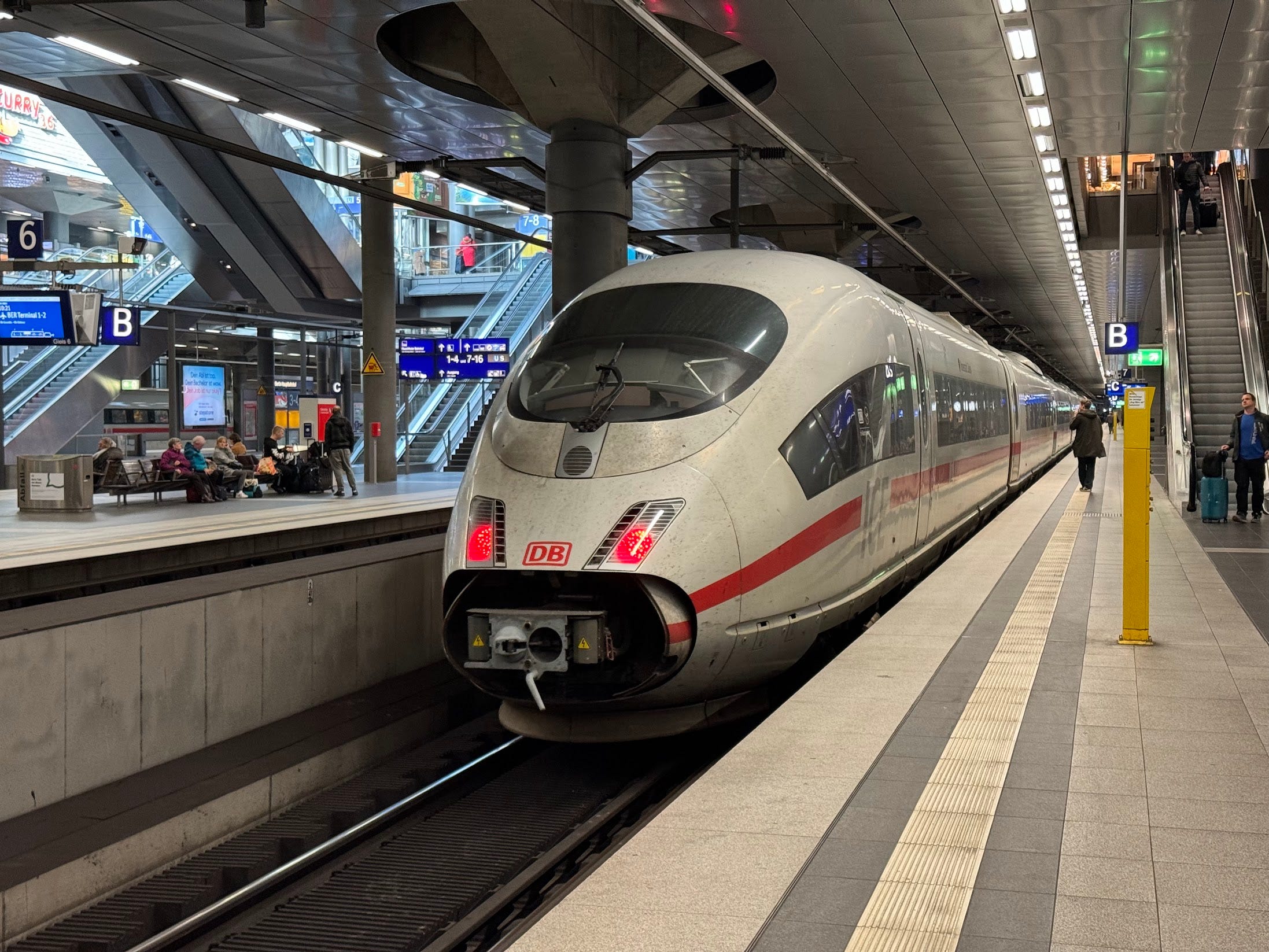
The government in oh-so-typical Canadian fashion promised almost immediately that this new infrastructure would connect … the small town of Peterborough, Ontario, which was surely something they did out of the goodness of their heart and not because of some weird electoral bug. And ironically, this is one of the only element that has felt entirely stable as the project turned into a high-risk, high-reward high-speed rail project.
Now, I've talked a lot about the problems with this project, from questionable assumptions about which cities should be served to the actual alignment, but what's absolutely clear is that we could make high-speed rail make sense — particularly from Toronto to Montreal. We've got huge density, fairly-big subway systems, major demand evidenced by the busy trains and numerous flights everyday. We also have population numbers and distances that makes sense. High-speed rail used to only exist in highly-developed and wealthy countries like Japan, France, and Germany, but these days it's also something that peer countries like Spain and Korea, not to mention developing nations like Indonesia and Morocco have, not to mention China. It's just one of the things that developed countries that aren't tiny all seem to develop, like public health care, and national highway networks. It’s just something the good places have.
The project — which, again, does have many problems — does have an emerging NIMBY problem as rural dwellers recoil at the idea of a train going anywhere near them.
Speaking of the problems, the majority of them feel like they would have been directly imported from either other Canadian transit projects, such as GO expansion in Toronto or from the general set of problems that seem to plague the English speaking worlds infrastructure projects.
A friend which closely follows NIMBY movements has been tracking this one, and suggested it was the largest and fastest growing he had seen.
Fortunately, all of Canada’s major political parties support high-speed rail, even the Conservatives who referred to it as “innovative high-speed rail” (it’s been around for decades so … alright, but at least the policy is sensible).
But, oh wait, actually their leader Pierre Poilievre, clearly channeling the energy of a small number of NIMBYs between the nation’s largest cities has just come out against the project. He says it should be cancelled. (Of course, he can’t cancel it because the party he leads lost the last election, and he didn’t even win his seat, needing to have an MP resign so he could drop into their safe seat).
Now, when making the case that it should be cancelled (a weak one, as you might imagine), Mr. Poilievre talked about it taking a long time, and about being expensive and pie in the sky. He talked about how Canada had built the CPR from coast to coast in four years (which feels a bit like saying that I built a new pipe to my backyard in a weekend and so obviously my city’s new sewer project taking five years is outrageous), which is true, and goodness it would be great if we didn’t sell our railways off so we weren’t starting from zero here. We might be able to build a little better had we not …

The issue is this all feels like the Poilievre who lost the last election. “How dare you try to do a big thing?” “The Liberal mismanagement is outrageous!” but then “we must cancel this project”. There is an admission of our incompetence — note the CPR comparison, as bad as it is — but then a tacit admission that they can do no better. We won’t fix the project or do a better job than the Liberals, we’ll just cancel it.
The issues here are many-fold. People actually want their governments to do things, even the most strident-free market Conservatives want a serious military, but then guess what? If you can’t competently build a big infrastructure project, you think you’ll be able to procure a complex military program? It’s remarkable how well-correlated cost and timeline blowouts on things like rail projects and military projects are, because they suffer from the same fundamental issues, and are founded on the same problems. Even with the Conservatives apparently pivoting 180-degrees from their position on this issue circa a year ago, they surely do want infrastructure to get built — highways, pipelines anyone? A government whose solution to a hard project is canning it isn’t going to suddenly grow capable on other types of projects.
When I mentioned this seeming desire not to ... build things … online, Conservatives rushed to say that Pierre would “cut red tape” on things like housing (something which largely is not his jurisdiction). But the issue is that sometimes you need infrastructure to support the housing. You can’t just check out of this core function of government!
And even if you think somehow that governments only ever have to say yes or no, and not actually action things — several people do point out that private companies have sometimes wanted to build stuff like pipelines themselves in the past, you still need to coordinate and do things like expropriation, which is a pretty key thing governments in the modern world need to do. Which is of course why Polievre came out against it on Alto. The issue is, if you take that attitude now, you really aren’t going to like what all the people in BC have to say about your pipeline: “What happened to no expropriation Pierre?!”
The other issue for Polievre is that Canadians seemingly didn’t elect his party because they wanted nation-building and big projects, and probably most importantly centrism (ok, I don’t think many people want actually some point in the middle of the political spectrum, but moderation ... ). The Liberals won not by appealing to the progressives, but because an NDP collapse let them appeal to lots of people who would be open to voting for the conservatives. The conservatives clearly have not learned the lesson. Winning votes from disgruntled farmers to kill a project serving cities which individually have millions of people each (Toronto and its suburbs have more people than BC, Ottawa more than Saskatchewan, and Montreal more than Alberta!) makes no strategic sense! Trying to code infrastructure as somehow a left-wing thing is exactly how you don’t moderate, when I hear someone online yelling about how high-speed rail through a corridor that includes more than 50% of the nation’s population is a “vanity choo choo”, it sounds roughly like when some progressive says something like “ban all pickup trucks”. The obvious actual move for a conservative party that wants to win votes from those who live in cities (most of the country) is to recognize that getting around, and congestion are problems (not to mention housing, which anyone who knows anything knows railways generally come with when done right!), and note that while the Liberals have failed to deliver better intercity rail in the past 11 years (which is true!) that they would actually tackle this problem expeditiously. Instead, it’s more or less, “we’ve tried nothing and we’re all out of ideas”.
Another thing I haven’t mentioned is that polling apparently sponsored by some of the NIMBY groups (ironically called AltNo) actually showed really broad support.
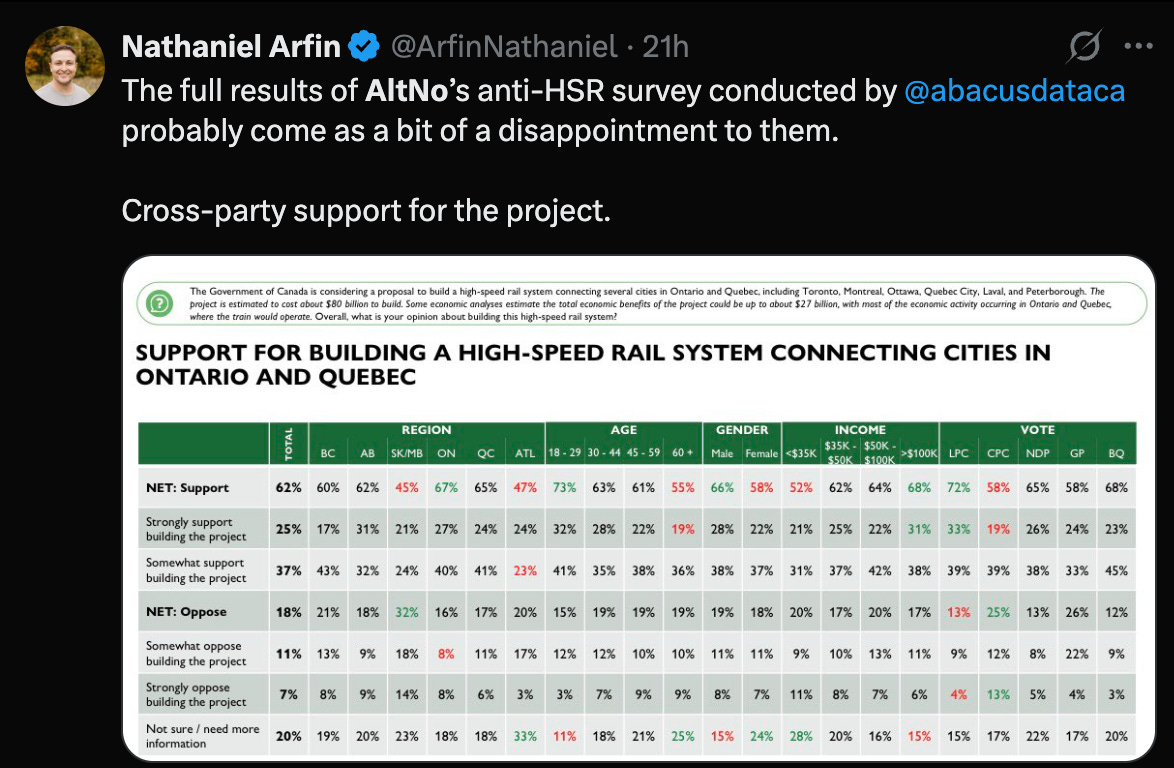
I point this out because we can see what a Conservative who cares about these things looks like. Doug Ford in Ontario, for all his problems, has been elected again and again. For his faults, Doug has been pushing infrastructure through at a crazy pace, and essentially nobody across the political spectrum on the whole thinks the new train lines, subways, and the like are a bad idea (even if they’ll quibble with the details). A friend has also pointed out that he actually does talk about actually getting things done and the incompetence of past projects — even if things don’t entirely seem to be improving. I can already imagine people saying “he’s not a real Conservative”, and all I can say to that is that it should probably really concern the “real” conservatives how effective he’s been at getting elected!
Now, I don’t want to give to much oxygen to silly arguments, but I think it is worth addressing the opposition I saw to the project online.
It’ll never happen! (From several Conservatives, including MPs … )
Not really confidence inspiring that your pitch to voters is that a technology that nearly every other major developed country — and several developing countries — has managed can “never happen” here. People have spent a great deal of time looking
It’s a train most Canadians will never ride, the west is funding another project for easterners! These provinces should fund it themselves!
Most Canadians live in Ontario and Quebec (>50%), most Canadian taxpayers live here as well. The project is national in scope, not provincial.
A pipeline is good for the economy, not some subsidized train!
Canada is a service economy, enabling larger agglomerations and people moving around is part of how we enhance that, and boost things like productivity. There’s a reason we are the only G7 country without high-speed rail, and might soon be the only G20 country in the spot!
Look at the Eglinton Crosstown!
Yeah, Ontario screwed that up badly. Fortunately the high-speed rail is being built by the people who built the REM, which went from idea to construction and operation quickly, and for a fraction of the price of Eglinton.
If it was a good idea the private sector would build it.
Ha.
Now, what may not come across here it I want the Conservatives to be better. I don’t think the current political monopoly the Liberals have in Canada is a good thing for anyone. However, when you live in a developed, urbanized country, where people are well-travelled and have often been to or are from countries with high-speed rail, coming out against high-speed rail is a completely daft take. Especially because it just generally gives off vibes of “we don’t take infrastructure seriously”.
The best of politics are when you’re able to reach into different political camps, take good ideas, and show how you can do it better. Instead of doing this, the Conservatives are playing to their base, which clearly hasn’t been delivering electorally.
Of course, maybe this time it will be different, but in the long run of history, being the people that robbed the nation of something that all the other developed nations have, or are developing, is ... not a good look.
Hi Reece,
Another great article. Here's a fun little fact: When the Toronto Bypass (now Highway 401) was being built, many of these farmers used the same arguments we see now with Alto.
However, after a little money, and expropriation, the highway was built.
I also find it very funny that Doug Ford is trying to pander to the NIMBY's by suggesting the train corridor follows Highway 401, but is very adamant on bulldozing swaths of land for the Bradford Bypass (Highway 413).
The next argument that we botched Crosstown, therefore we can't build rail is also flat. I cannot speak about what happened, but the conditions that caused Crosstown does not apply to exposed rail. We are also forgetting places like Vancouver, who built the SkyTrain in a fairly quick manner.
All in all, I've kinda taken a step back with the public transit discourse, especially online. It can get very draining, and it reminds me of mudslinging at times. It's nice to read a level-headed article with nuance.
Thanks Reece, happy long weekend.
Best regards,
What few want to discuss is why a passenger railway has to be in the public sector, and why pipelines can be in the private sector. Also, what few on either side want to discuss what the largest barrier to building pipelines is today and how it applies to railway construction, and how REM was the exception to that. Or how the failure to be an of exception was the cause of CDPQ withdrawing from REM East.
There are private and public goods, and costs of choices made by individuals that affect many others. Other highway users of crowded highways have cause to want as many others as possible to be taking other means. Every driver who has a cause such that transit or inter-city rail is not good for them (excessive baggage, a bunch of people traveling together, etc.) should hope that it is the best choice for as many other potential drivers as possible. A single train carrying 600 people is likely removing 400 or so cars from the road. The difference between 1800 vehicles/hour and 2200 in a lane is the difference between crowded flow and stopped. The lion's share of the benefit of that railway does not find its way into the market transactions.
Having said that, stability in the regulatory regime, the ability to actually plan and move forward without constant political risk and demand for changes that are simply not viable, and also not seeking the maximalist projects that will create their own failures, are all requirements for getting things done. This, along with no dangerous political grandstanding to create risk that is not required. I will be the first to say, the Ottawa-Montreal portion of the project for high speed should be the easiest, and the hardest to create honest doubt about alternatives around. Even if looking at this in city pair terms (how I believe it should be) this is the portion that Via already owns, that requires substantial straightening to make fast, and the one with the least outlandishly expensive construction.
I have real doubts about the Toronto Ottawa proposals, serious questions about a stop in Peterborough and how that would make sense, given the travel time implications for the entire route. If you are ok with that, why not just invest in the existing Montreal-Toronto corridor, removing level crossings, straightening the few spots where 200 kp/h plus speeds are not possible now, and add 2 more pair of tracks? The promised travel time requires an average travel speed just shy of 190kph, where the 70km across Ottawa, and the 60 or so on approach to both Montreal and Toronto are likely to be below 120.
That is likely 100 minutes of the promised 180 will perforce be required to cover the 190 km of the 560 or so km (leaving 80 minutes to cover the remaining 370). So, 5 minutes stopped, plus slowing, and speeding up for Peterborough would seem material. Even a 5-minute stop would likely mean losing 7 or 8 minutes in travel time, time you don't have if you are actually making that trip in 3 hours. We need to be making rail more time and comfort competitive, spending the minimum dollars for the maximum effect, which means time from departure to arrival, not the vanity of maximum speed. We need to build a lot of infrastructure to make that happen, but it should be for the maximum benefit. It may be that the best way to achieve reduced travel times also happens to reduce risks associated with freight rail operations, and make them more competitive with highways as well. Again, if you are stuck in a car, because you are moving your sister to Montreal for school, would you not be happier to have fewer trucks and cars sharing the road with you?