

Everything is not all right with subway construction.
Montreal needs to get its act together.

Nowhere in Canada is the transit construction cost crisis more obvious than in Montreal.
The city is simultaneously building the REM (well — the CDPQ, Quebec’s public sector pension plan, is building it) for about 150–200 million CAD per kilometre, while the STM, the city's transit agency, is currently building its Blue Line metro extension for nearly ten times more — close to 1.5 billion CAD per kilometre, some of the highest prices ever seen for a subway. Both systems are “metros” in that they feature trains that travel on dedicated tracks free of cars or pedestrian crossings at high frequency. While some of the difference in price is easily explained — but not justified — by differences in train length or tunnelling, much of it is not.
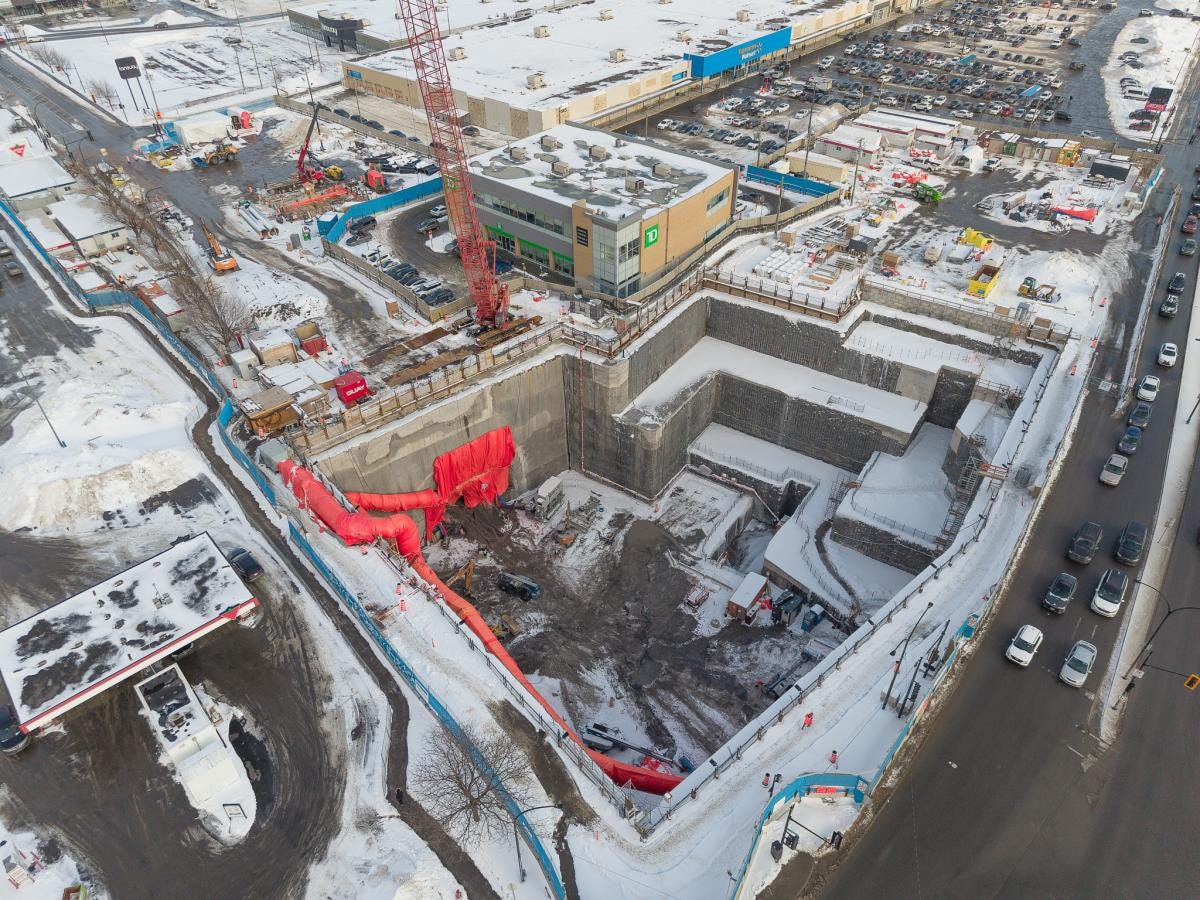
The issue of booming construction costs is a massive problem in Canada and has traditionally not gotten a lot of thoughtful media coverage. You’d hear that costs were skyrocketing, budgets had been blown, and often raw numbers would be given, but they’d never be contextualized. This is fortunately starting to change. A recent Montreal Gazette article is literally titled “Costs for public transit projects in Montreal are out of control, experts say”.
While I am genuinely happy to see this getting any serious attention in legacy media, I think the article lacks substance. They are right that costs are high and at least show how much they have gone up adjusting for inflation — but they do not mention:
Costs are now on the order of ten times higher than the global median.
The REM, which was going to be further expanded before the city shut that down, has come in dramatically closer to those global median prices.
The REM is also a metro system.
The paper does talk to several academics about the problem and they absolutely get the main issue right.
“The costs are through the roof for transit projects,” Siemiatycki said. “It’s out of control, and worse, it’s out of line with what our peers are doing. And this is troubling for all sorts of reasons.”
However, there are some pretty glaring holes in their analysis — or at least what went to post — which I will discuss in a moment.
Don’t miss a single post. Become a subscriber today for the latest on public transport in Canada, and beyond.
What’s worse, is that they cite an STM official on the Blue Line project who gave the following almost hard-to-believe statement:
“We have proven that the costs of the project are in line with the (worldwide average),” Chartier said. “I think we’re even a little more competitive.”
To start with what I hope is obvious, it is deeply concerning that someone speaking to large metro projects in this country is either ignorant of the reality that their project is dramatically above the worldwide average, or lying to the public. I’m not sure what is worse.
Keep reading with a 7-day free trial
Subscribe to The Transit Brief to keep reading this post and get 7 days of free access to the full post archives.