

Automate the trains!
A path to global train abundance.

Before we get to our main content, Reece was recently on “The Line”, a podcast on Canadian politics, talking about our project delivery losses, but also wins. It’s a good conversation.
Rail automation should be much more widespread in Canada, and would unlock a massive expansion in transit service as well as improvements in speed, but this doesn’t look how you imagine.
This posts lessons on rail automation, how it came to be, the safety issues with mainline rail, and why more driverless trains would be a good investment are relevant to virtually any city that wants to run more trains for less.
A recent CP24 story out of Toronto on cancelled suburban trains actually has lessons in it for the whole country — lessons of automation, and lessons in what is, and is not, possible. “GO Transit cancelled more than a dozen train trips Saturday. Here’s what’s impacted. (sic)”
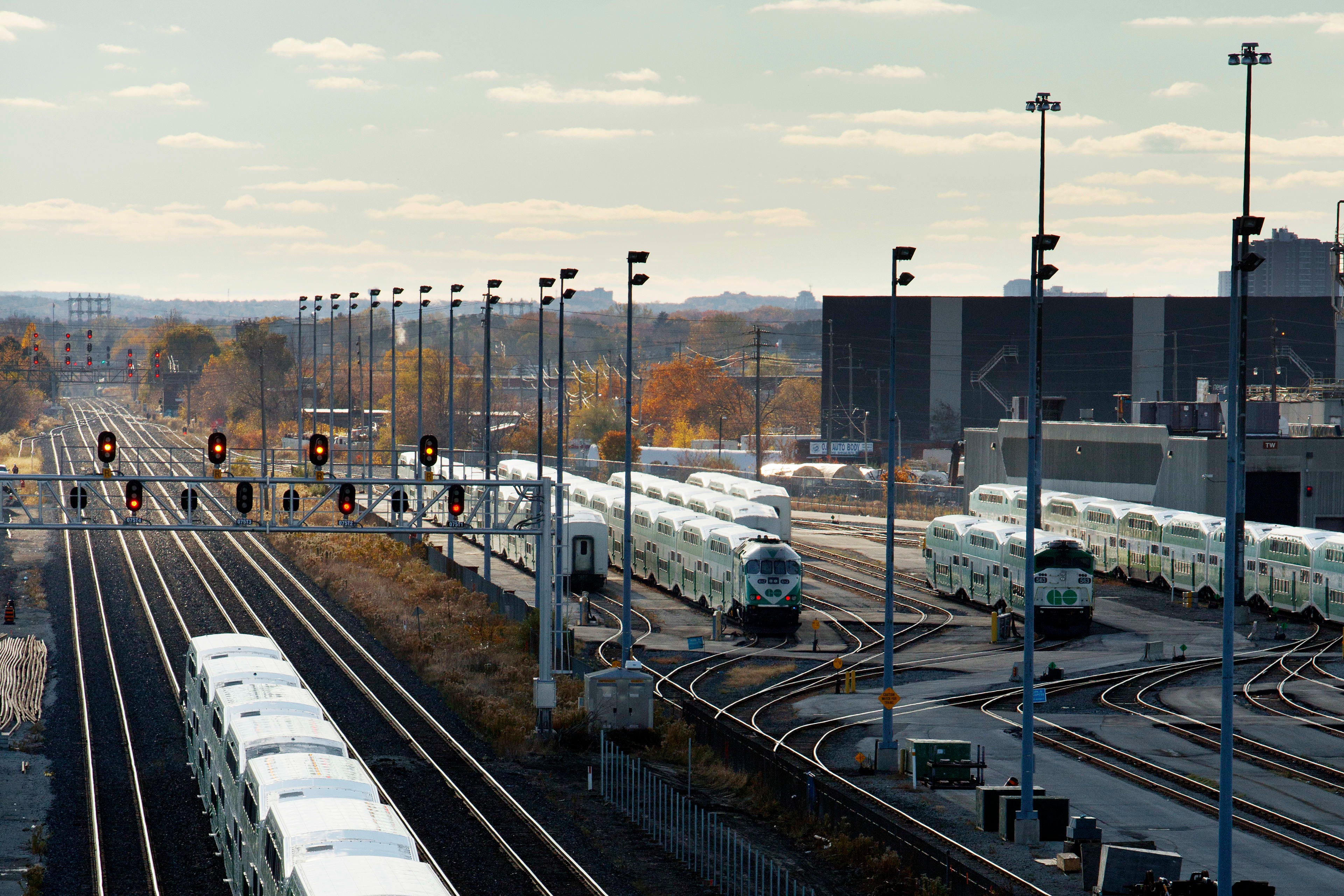
The GO Story
The story isn’t all that complicated. Metrolinx, the regional transit agency for Toronto and increasingly all of southern Ontario — they just added daily service to Stratford, roughly 150 kilometres from Union Station — runs a significant, if not impressive, number of trains in and out of Toronto. Over the past decade or so, the number of trains being run has increased substantially — trains now run on weekends and outside of peak commute hours on five of the seven GO train lines; they are also running more frequently than ever. On the Lakeshore route from Oshawa to Burlington, and from downtown to the airport, trains run so frequently that you can just show up at a station and catch a train; it’s the subway model. Even on the lines to Barrie, Brampton, and Markham, trains run every hour or better into and out of town all day — a boon for a world where people travel for reasons other than work, and workers sometimes want to leave early or start work late.
Hourly service is decidedly basic — it’s the service you’d get between all but the most minor towns on rural rail lines in the UK (services akin to GO into London run as frequently as every few minutes) — but it’s a sea change from the days where there were just a few trains into the city in the morning and out at night.
The thing about running more trains is that you need more train drivers. The old way that GO ran trains, with a crew taking a train from the suburbs to the city, hanging out for a few hours and parking the train on the most expensive real estate in the country, then driving it back at night, is horrifically inefficient — this is something that is only really done in North America, and nowhere more than Toronto. The shifts are irritatingly split (which is expensive for Metrolinx), and a more sensible operation has some number of trains running up and down the lines all day, reducing downtown parking, giving people more options, and “sweating the assets.”
Increasing service on suburban train systems does cost money, in some cases a lot of it, but the result of that is unlocking a lot of value and actually improving the cost-effectiveness of the system by more effectively using human resources, real estate, and obviously the trains themselves.
To run all of these additional services, Metrolinx and Alstom (formerly Bombardier), who run the trains on their behalf, have been aggressively training new staff. The issue is that changing operating plans (German national railway Deutsche Bahn was set to take over last year, a plan that was cancelled) and constant attrition to higher-paying jobs in freight rail (something that can largely happen because the same antiquated control systems and operating rules used on freight are also used for passenger trains in Canada) means that staffing the system is like mending a leaky ship. The complexity and multi-year training process does not help.
Don’t miss a single post. Become a subscriber today for the latest on public transport in Canada, and beyond.
Train as Robot
A natural point then, given the struggle to staff the system up, is “why not just automate?” — it’s not a question we even need to raise, as netizens already are. In the age of Waymo, more and more people are asking this in cities all around the world.
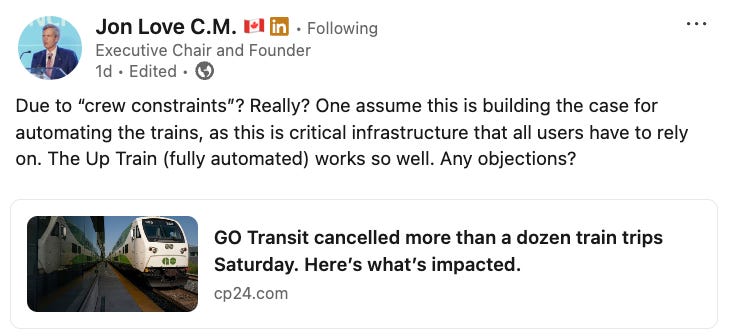
An important aside is that the UP Express train from Toronto Pearson airport to Union Station is not, in fact, automated at all — much less fully — and instead operates in the same way as a GO train. We would like to suggest that public figures boldly claiming things which are patently false, with no serious sense of the relevant subject matter, should probably refrain from doing that.
And the truth is, automated trains are nothing new, but all train systems are not the same.
Not New.
Canada is actually a real trailblazer in automated train systems. The Vancouver SkyTrain network has been safely operating and growing every few years since 1986, and the system relied on trains and electronic control systems built in Canada (and since used around the world). Since then, the world has opened more and more automated train lines, with a large percentage of new subways featuring no drivers — some entire systems, such as the subways of Singapore, Sydney, and Copenhagen, entirely consist of driverless lines.
Even in Canada, Montreal opened a new network in 2023 that will soon stretch over 60 kilometres, using similar technologies as SkyTrain, and Toronto’s new Ontario Line subway will also be driverless.
... But only new.
For a long time, driverless train systems consisted only of newly-built systems designed from the ground up for automated operation.
Part of the reason automating existing train systems has not been a real priority is that most train systems do not face the same crewing challenges as GO. Train driver jobs are well paid (as one would hope for such a safety-critical job) and typically unionised, but other systems also are far less staff-intensive. At the same time, having a trained member of staff who can evacuate a train and help in the event of an emergency is not a bad thing. Driverless train systems do still have lots of staff, who become more important when a system gets busier and incidents can create bigger problems. The main benefit here is that on a driverless system, fewer staff need to be trained to drive the trains — since that’s only needed in emergencies — and more of a customer service role can be taken on.
GO trains are not like most trains; each has three staff members — two people at the front of the train, and a customer service agent in the middle who controls the doors and deploys the ramp. This status quo is not good, and it is very expensive. Staffing is one of the main costs of a rail service, and while most urban rail services have a driver and that’s it, GO trains have roughly triple the operating cost.
The Birth of Automation
It’s important now to note that automation is a funny term with respect to railways. While lots of train systems have drivers, many such systems are still automated to varying degrees, largely thanks to a series of progressive innovations.
The automation of train systems has largely been driven by urban subways, where lots of trains operate close together in winding tunnels where drivers cannot see far enough ahead to stop as needed in all conditions. The inability to stop in time forced the implementation of signalling systems — a term that sounds so boring that we can already imagine the light leaving your eyes — and these systems initially just indicated whether trains could proceed, or should slow or stop based on the status of the tracks. More lights (known as signal aspects) were added over time to do things like enforce speed limits. Additional equipment ensured drivers were alert by requiring them to press a button or hold onto something, while train-mounted systems meant that a driver who disobeyed a red signal could have the train’s brakes thrown on automatically.
This process of creating various safety systems eventually meant that getting a computer to drive the train was practical with the right train and track systems: once the doors close, accelerate to the speed limit of the current section of track; as you approach a station, decelerate to a standstill to line up with the platform; monitor the signals, and slow down and stop as needed along the way. The first systems, which we refer to as Grade of Automation 2, were running in the 1960s and basically turned the driver into a door operator and button pusher — pressing the start button once the doors successfully closed, and being ready to stop the train if something got in the way. This is the way most subway lines which are not driverless operate today.
SkyTrain then was just a step further along this journey. CCTV and fences made sure nothing could block the tracks between stations, and within stations, pressure plates along the tracks, and later sensors akin to those used to stop a garage door closing on you, were used to make sure nobody jumped onto the tracks. Doors closed automatically like they do on an elevator. The same fundamental technology is how people mover trains at airports work.
Driver’s Little Helper
It’s fair then to say that while only a fraction of train systems are truly driverless, a substantial minority are automated in the sense that the driver is really not a driver at all, but more an attendant just working with the automated systems of the train, and rarely actually controlling the throttle or brakes.
Automated driving has been transformational for subway systems. Computerised systems can drive as well as the best driver on their best day, every single time. This speeds up journeys, safely lets trains operate just metres apart, and is dramatically more energy efficient, while also reducing wear on trains and tracks.
The Upgrade
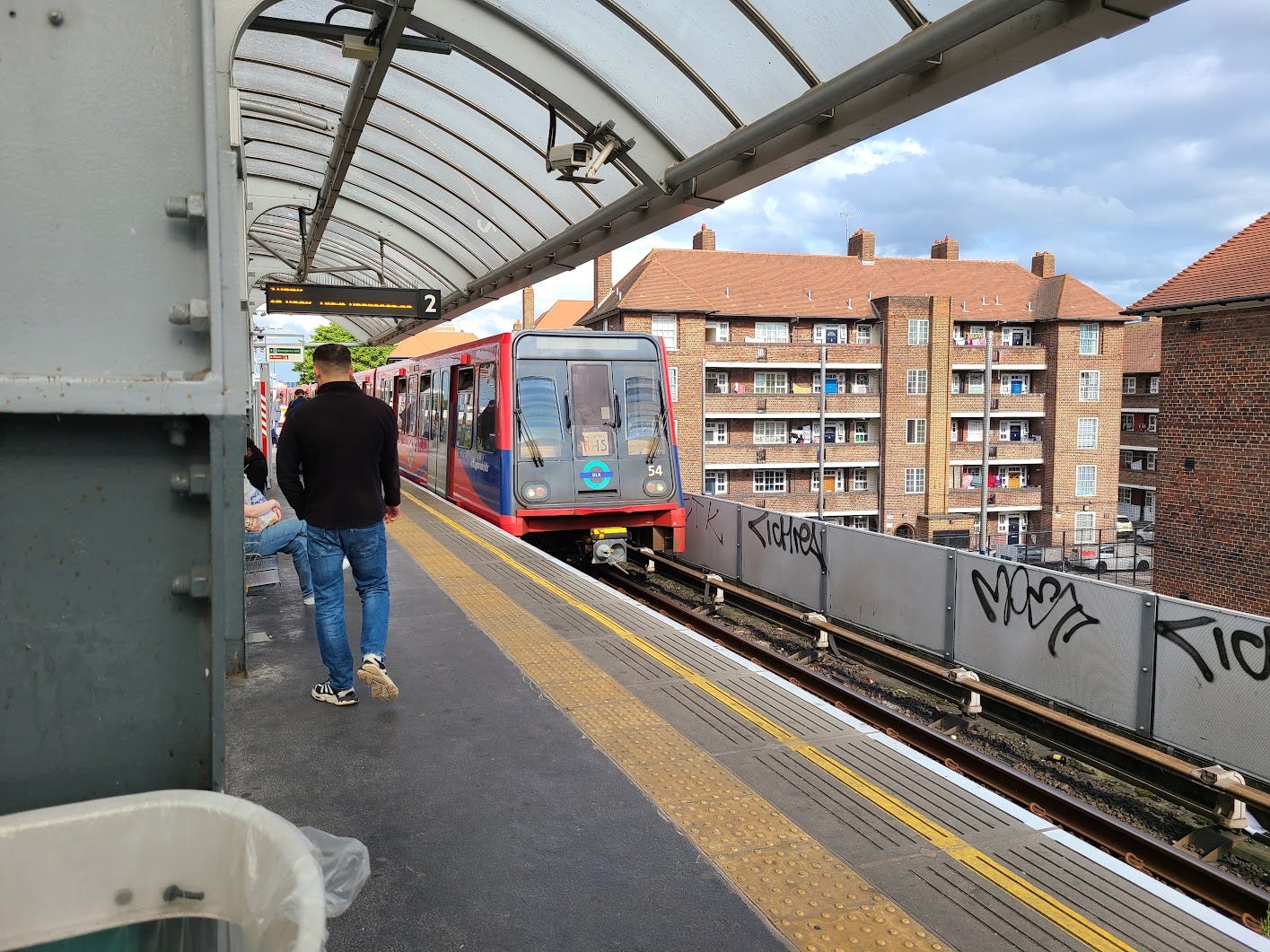
For a long time, there was a fairly strict divide between driverless train systems and older legacy subways, which were mostly computer-driven but required staffing to stop the trains if someone entered the track area, as well as to control the doors. However, that divide has largely come down.
Don’t miss a single post. Become a subscriber today for the latest on public transport in Canada, and beyond.
In the late ‘90s, Paris did something novel with its new Line 14. While early automated train lines were limited to smaller cities, or minor lines in bigger cities, a major subway line that formed a critical transport artery for a major centre was not something that had been widely tested. Line 14 did this and was a smashing success, with trains running efficiently and safely. This project led the Paris metro authority to investigate converting older lines for full automation in order to expand capacity, but clearly also as a counter to frequent strikes from metro drivers. The honest truth is a well-functioning rail system can save money by getting rid of drivers, but will also move so many people with each run that the incentive is not as huge as it seems — this is not Uber.
The idea of automating lines to disrupt organised labour is certainly a regular threat, and automation does reduce staffing; however, as Londoners know with the automated Docklands Light Railway in the east of the city, the staff in the control room can also strike.
As it turns out, this approach worked, and Paris managed to fully automate Metro Line 1, one of the system’s busiest, back in the 2010s. This process involved upgrades to signals and control systems, as well as new trains and platform safety doors. It managed not only to fully automate a line dating from 1900, with tight stations and curvaceous platforms, but to seriously expand capacity on the line.

Since then, Paris, and various other cities have automated more metro lines, such that it’s now fairly standard, if not common practice.
Can we do it on GO?
Automating the GO trains as you might imagine is a different story.
While not necessarily an issue, no diesel-powered passenger rail system has been fully automated — subways, after all, are all electrically powered. This is because diesel rail systems are shockingly energy inefficient, and automating a system before you’ve electrified it — something Metrolinx is working towards for GO at an agonizingly slow pace — is a bit like trying to install a theatre room in your house before you have running water.
Level crossings are a bigger issue. No current fully automated rail system has any, but the GO train system has quite a few. While with modern technology clearly there is no technical reason these need to be a barrier, the issue is of the same type as the lack of electrification. A frequent urban rail system should not use heavy, slow trains running on dinosaur juice, and probably also shouldn’t have level crossings where pedestrians could be hit and cars could block trains. These issues are just much more urgent and pressing than getting rid of drivers, even if you could work around them.
Driverless rail systems with level crossings seem like an inevitable thing; after all, Waymo appears to be fairly competent at driving a car, which is much more complicated than driving a vehicle on rails. Clearly, sensors of the same conception as those that prevent people from going on the tracks on the SkyTrain could be used to check level crossings (radar is sometimes used in Europe, automatically turning signals red if a crossing is blocked), and cameras and sensors on the train could do the rest of the work.
The thing is, while you could do these things, getting rid of level crossings and buying better, more efficient electric trains are things we need to do anyways. If someone is going to take on the technical, safety, and regulatory challenges of innovating to expand the reach of automation, let it be the Swiss (where 100% of the passenger rail kilometres are automated to some degree), and let’s avoid a costly boondoggle and focus on the basics.
The biggest problem is honestly the lack of any modern signalling system on GO, or for that matter any mainline railway in Canada, which means we have a shocking number of train derailments, constant near misses that could easily become mass casualty events, and a rail system which most developed countries would find unacceptably unsafe.
Right now, we need two people at the front of every GO train because things like speed restrictions and differing conditions are not automatically pushed to drivers as they run the trains through different areas, but are provided as a paper book which one person must read and cross-reference with railside mileposts (really — and yes, we use imperial measures for our railways).
That technology that would stop a subway from going past a red signal and derailing or slamming into another train? It does not exist on GO, where trains can carry thousands of people. Every few months we seem to roll the dice again, as industry experts remind us this was a solved problem in Europe over 50 years ago, and our rail system would violate all manner of rules over there — rules that, as experts remind us, “were written in blood.”
We truly would not build a new system with the wide-open safety setup of the GO trains — even trams have more protection — but because it falls under the banner of mainline rail, we accept it.
While experts and regulators note that Canada’s rail systems are currently “safe” — an assertion based on the fact that we have not had a major crash — all it would take is a derailed GO train killing tens, if not hundreds of people to change that. It is something which our systems do not currently prevent in the same ways as those in places like Europe or China. A disaster like that would instantly make clearing house at the regulators and imposing rules — such as those that exist across most of the developed world — an immediate political imperative.
Fortunately for GO, a new signalling system — the very good, highly customizable, multi-vendor, and internationally used European Train Control System (ETCS) — is in the very earliest stages of deployment. This is the system that will not only eliminate most of the aforementioned safety risks and leapfrog us to a modern system not even rolled out everywhere in Europe, but creates the basic infrastructure to control trains digitally and monitor trains’ exact locations in real time. While ETCS does not make the GO trains driverless, it should let just one person operate a train. With a much lighter workload allowing that driver to control doors when stopped at a station, alongside raised platforms to allow wheelchair access at every door without a human-deployed ramp, we could in theory get trains down to one staff member. It also creates the basic infrastructure that you would one day need to transition to full driverless operation, which gets closer to reality with each level crossing we remove.
While long automated subway lines like the new REM system in Montreal mentioned above do exist, “mainline” rail systems — that is, routes connected to a national network — have not yet been fully automated. Since most suburban train networks like GO have some interaction with broader national rail networks that serve intercity and freight trains without the necessary equipment to be automated (or even necessarily safely operate around automated trains), as well as level crossings, automation here is more difficult.
Copenhagen, which has over time removed level crossings from its suburban train system (the S-tog) and has those trains on entirely separate lines — effectively “airgapping” it like a subway — is currently undergoing the process to automate the system line by line. This will make it the largest automated rail system in the world, and may yet be another Paris moment.
This form of labour-saving automation doesn’t mean job losses. To the contrary, deploying a system like this would mean much simpler driver training and a clear path to take those other two staff members and train them to also drive trains, enabling far more service.
The Rest
It’s worth quickly looking at the potential for automation across the rest of the country’s rails.
Other suburban train systems exist in Montreal and Vancouver, but the very limited service, lack of infrastructure ownership, and heavy freight traffic probably make any automation here significantly less likely than the already years-out GO system.
On the subway front, Vancouver is of course fully automated. Toronto, Montreal, and Ottawa all have a mix of “subway” lines with no level crossings that would be good candidates, and in each city at least one line already has Grade of Automation 2 operation, enabling frequent service with minimal driver input — each within spitting distance of full automation. The deployment of such a system on Line 1 in Toronto was what helped justify removing one staff member from trains on that part of the system. Montreal, having a very similar metro system to Paris, would be a shoe-in to automate a line, particularly the under-extension and upgrade Blue Line — Vancouver importantly reminds us that this can be done without platform doors, even if those are obvious for other reasons. That Montreal is not doing this not only highlights a lack of vision and awareness for goings-on across the Atlantic, but also the huge cost savings that the city is missing out on by failing to make up for smaller, less expensive stations by running the trains more often.
For the light rail lines operating in Toronto, Calgary, Edmonton, and Waterloo, automation is unlikely to happen anytime soon since there are lots of level crossings and interactions with pedestrians and cyclists. Again, it may be technically possible, but it both seems more likely and responsible that we follow jurisdictions in Europe on this, and none of them are doing such automation at any scale, much less using off-the-shelf products. The Eglinton Crosstown light rail is a strange case because it has Grade of Automation 2 operations, but only where it is fully separate from traffic and, in effect, running as a subway.
So?
And yet, automation is still a worthwhile pursuit. For GO trains and trams, more safety systems would be welcomed and, as you can see, would lay the groundwork for future driverless operation decades down the road. For the subway systems in our biggest cities, the case, like with platform doors, is obvious. Canada is very willing to spend capital dollars on new lines and upgrades in our cities, but is stingy with operating funding that actually runs trains and buses and gets bums in seats. Investing dollars in automation upgrades where easily doable would convert capex dollars into opex, and make getting around our cities easier.
For the GO trains, let’s just focus on not having two people up front.
Keeping abreast of the transit networks across all of Canada’s big cities takes a lot of time and commitment. The Transit Brief lives and dies by your support. To receive new posts and support my work, consider becoming a free or paid subscriber.
Thank you.
If you enjoyed this post, consider sharing “The Transit Brief”.
Made with love, in Canada - 2026.